
A Botanical Illusion
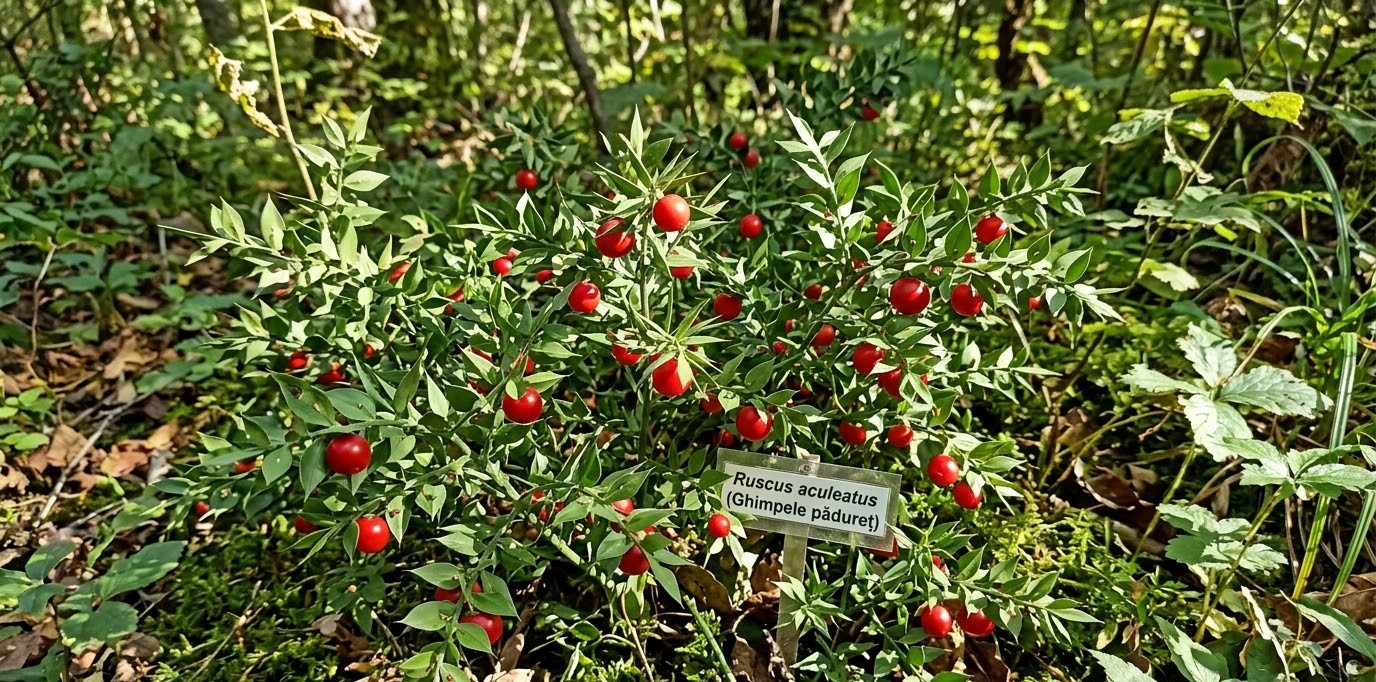
The most fascinating thing about Ruscus aculeatus is that it doesn't actually have leaves.
- The Cladodes: What look like stiff, pointy leaves are actually flattened stems called cladodes. They perform photosynthesis just like leaves, but they end in a sharp spine to protect the plant from being eaten.
- Flowers on "Leaves": In a rare botanical twist, the tiny, star-shaped flowers (and later the red berries) appear to grow right from the center of these "leaves."
History and Traditional Uses
- The Butcher's Tool: Its English name comes from the historical practice of butchers who used bundles of its stiff, antibacterial branches to sweep and clean their wooden blocks.
- Romanian Folk Medicine: In local tradition, the root (rhizome) has been used for centuries to treat circulatory issues. Today, it is still a valued ingredient in natural remedies for heavy legs and vein health.
- Protection: In some villages, it was placed at the entrance of barns or houses to deter rodents, thanks to its needle-sharp tips.
- In Romania, the Ghimpe pădureț is a protected species. It is a slow-growing plant, and its presence is a sign of a healthy, ancient ecosystem.
- Winter Beauty: While most of the forest turns brown or white in winter, the Butcher's Broom remains a vibrant, glossy green with pops of scarlet red berries, providing essential food for birds and small mammals.
FAQ: The Butcher’s Broom (Ghimpe Pădureț)
Is Butcher's Broom a protected species in Romania?
Yes, Ruscus aculeatus is a protected plant in many regions of Romania. Due to its slow growth rate and the fact that it is often harvested illegally for floral arrangements or traditional medicine, authorities have placed it under protection to preserve the biodiversity of the southern forests.
Can I eat the bright red berries?
No, the berries are toxic to humans and can cause vomiting or other digestive issues if ingested. While they look like small cherries, they should only be admired and photographed. In nature, they serve as a late-winter food source for birds.
Why does the fruit seem to grow directly out of the leaf?
This is a unique botanical feature. The "leaves" are actually flattened stems (cladodes) that have taken on the role of leaves. Because they are technically branches, the flowers and fruits grow out of them just as they would on a normal stem.
Where exactly in Romania can I see this plant?
It thrives in warmer, shaded areas. The best places to find it are the Iron Gates Natural Park (Cazanele Dunării) (see more), the forests of the Mehedinți Plateau, and parts of the Banat region. It prefers limestone soils and the shelter of oak or beech forests.
What are the medicinal properties of Butcher's Broom?
Historically, the rhizome (the underground part) has been used in Romanian folk medicine as a powerful diuretic and to treat circulatory disorders. Today, it is recognized globally in herbal medicine for its ability to reduce inflammation and improve blood flow in the legs.
Is it evergreen?
Yes! One of its greatest charms is that it remains a deep, glossy green throughout the entire winter, even under snow. This makes it very easy to spot in the "naked" winter forest.
