
The Legend: Tears of the Mountain Spirit
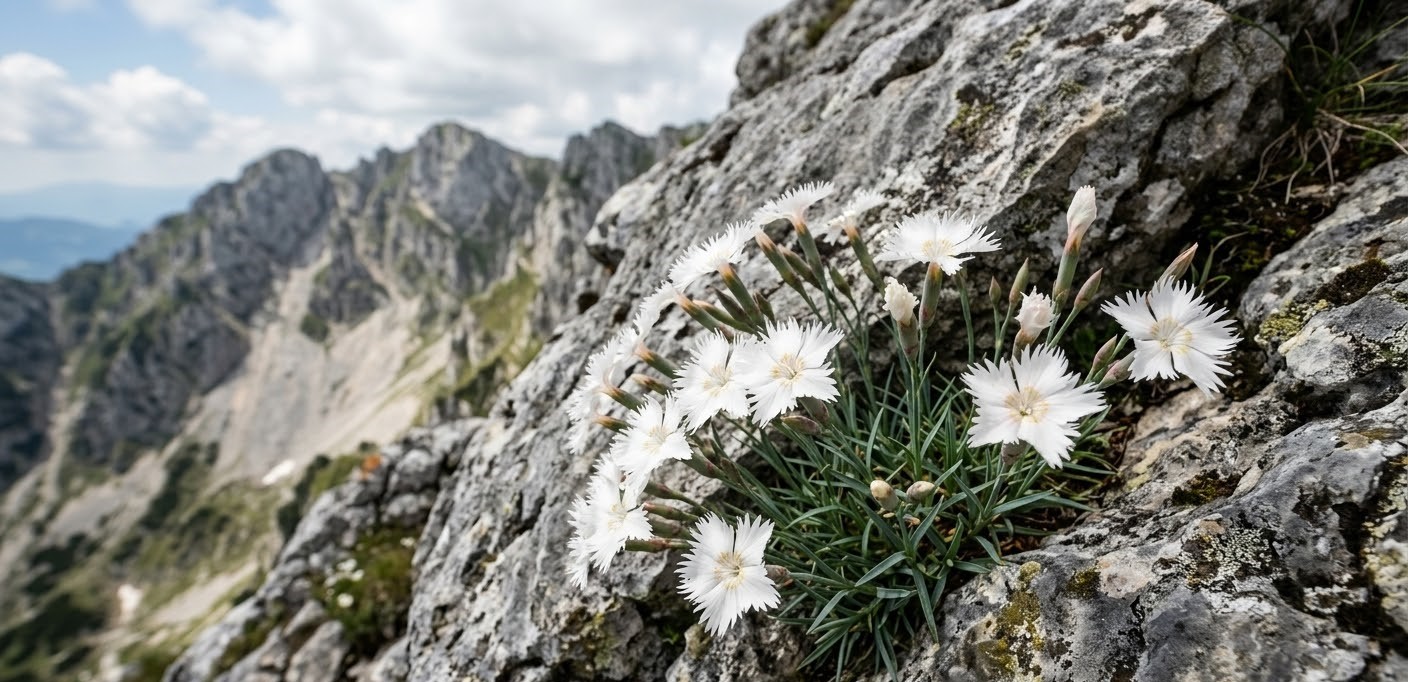
In local mountain folklore, these white fluted flowers are said to be the "tears of the mountain spirits" (fetele de piatră). Legend has it that when the spirits of the high peaks saw the first shepherd climbing the dangerous vertical walls, they shed tears of admiration. Where their tears hit the cold limestone, these fragile white carnations bloomed, offering the shepherd a "grip" of beauty in the gray stone.
Biodiversity & Habitat
The White Cliff Carnation is an endemic species to the Carpathian arc, meaning you won't find it anywhere else in the world in its natural state.
- Vertical Life: It grows in dense tufts directly on limestone cliffs and rocky screes, often at altitudes between 1,000 and 2,500 meters.
- The Scent of the Heights: Unlike many alpine flowers, it has a very subtle, sweet fragrance that is most noticeable in the early morning dew.
- Protection: It is a protected species. Travelers are always reminded: "Take only photos, leave only footprints."
- The "Lace" Petals: Its petals are deeply fringed, looking like delicate handmade lace (similar to the traditional Romanian dantelă).
- Limestone Lover: It is a calcicole plant, meaning it literally "eats" the calcium from the limestone rocks it grows on.
- Survivor: It can withstand extreme winds and freezing temperatures that would kill most garden flowers.
Scientific Name: Dianthus spiculifolius
Flowering Period: June – August
Habitat: Calcareous (limestone) rocks and alpine meadows
Origin: Endemic to the Carpathian Mountains
A nice short video presenting White Cliff Carnation (Garofița Albă de Stânci):
FAQ: The White Cliff Carnation in Romania
1. Where is the best place to see the White Cliff Carnation?
The most impressive displays are found in the Bucegi Natural Park and Piatra Craiului National Park. Look for them on sunny, vertical limestone walls or rocky ridges at high altitudes.
2. Is it legal to pick these flowers?
Strictly no. The White Cliff Carnation is a protected species in Romania. Picking it not only harms the fragile mountain ecosystem but can also result in significant fines if you are within a National Park boundary.
3. When is the peak blooming season?
While they start appearing in June, the best time to see them in full bloom is July. By late August, the flowers begin to fade as the mountain weather starts to cool down.
4. Why does it grow only on rocks?
This plant is a specialist. It has evolved to survive in "niches" where other, more aggressive plants cannot grow. The limestone provides the specific minerals it needs, and the lack of soil prevents larger plants from shading it out.
5. How can I distinguish it from other mountain carnations?
The key features of Dianthus spiculifolius are its pure white color and the deeply fringed (shredded) edges of the petals. Most other wild carnations in the Carpathians are pink, purple, or have solid petal edges.
6. Is it endangered?
It is considered a rare, endemic species. While it is not currently on the brink of extinction, its habitat is limited to the Carpathian peaks, making it very vulnerable to climate change and heavy tourist traffic.
