
A Subterranean Masterpiece of Nature
Topolnița is not just a cave; it is a giant labyrinth carved by the Topolnița River. It is famous for its massive formations and diverse landscapes, ranging from narrow passages to enormous halls.
- The Racoviță Gallery: Named after the famous Romanian explorer, Emil Racoviță (see more). this is one of the most beautiful sections, filled with delicate stalactites and stalagmites.
- The Forest of Candles: A breathtaking chamber where thousands of thin, white formations rise from the ground like a petrified forest of candles.
- The Giant's Hall: A massive space where you truly feel the immense power of the Earth's geological forces.
Access and Preservation
Because of its extreme scientific value and the fragility of its ecosystem, the cave is a protected natural monument. It is only open to the public once a year, during the "Topolnița Cave Festival" in August. For the rest of the year, access is restricted to professional cavers and researchers, which has helped preserve its pristine beauty.
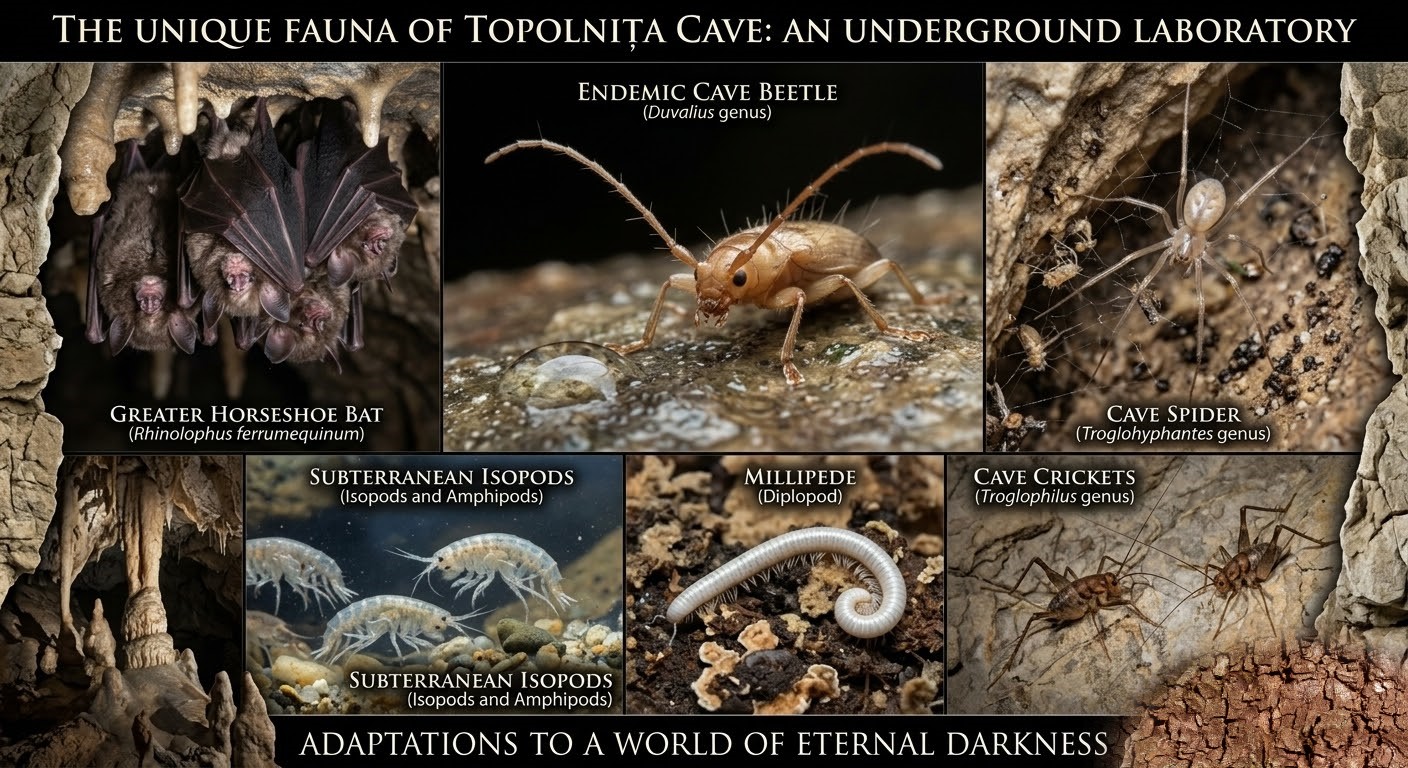
The Alien Life of the Abyss: Unique Fauna of Topolnița
Beyond the stone curtains and crystal forests, Topolnița Cave is a living ecosystem where evolution has taken a different path. In this world of eternal darkness, animals have traded their eyes and colors for extraordinary senses.
- The Masters of the Dark: The cave is home to several species of troglobites—creatures that spend their entire lives underground. Among them are rare species of beetles (Duvalius genus) and spiders that have lost their pigmentation, appearing almost translucent or ghostly white.
- The Bat Sanctuaries: Topolnița hosts significant colonies of bats, including the Greater Horseshoe Bat (Rhinolophus ferrumequinum). These "guardians of the cave" are vital to the ecosystem, as their guano (droppings) provides the primary source of nutrients for the smaller insects living in the deeper, isolated galleries.
- Unique Endemic Species: Scientists have identified species of isopods (tiny crustacean-like creatures) and diplopods (millipedes) that are endemic to this specific cave system, meaning they exist nowhere else on the planet. To them, Topolnița is not just a cave, but their entire universe.
- Sensory Evolution: Since eyes are useless in total darkness, these creatures have developed extremely long antennae and sensitive hairs that allow them to "feel" vibrations in the air or water, detecting predators or prey from meters away.
- A Natural Laboratory: Scientists have discovered unique fauna here, including species of cave-dwelling insects that exist nowhere else on Earth.
- The Underground River: The Topolnița river still flows through the lower levels, constantly reshaping the cave's architecture.
- Traces of the Past: Archaeological findings suggest that the entrance areas were used by humans in prehistoric times for shelter.
FAQ: Secrets of the Topolnița Cave
1. Why is Topolnița Cave considered a "Subterranean Giant"?
With a total length of over 20.5 kilometers, it is the 4th longest cave in Romania. Its massive galleries are spread across 5 different levels, making it one of the most complex cave systems in the entire Carpathian mountain range.
2. Is the cave open to the general public?
Access is strictly regulated to protect the fragile formations and the colonies of bats. Usually, the cave is open for visiting only one day a year, during the "Topolnița Cave Festival" (Sărbătoarea Peșterii Topolnița) held in August. Professional cavers with special permits can access it year-round.
3. What makes the "Forest of Candles" so famous?
The "Forest of Candles" (Pădurea de Lumânări) is a gallery filled with thousands of extremely thin and tall stalagmites. They are composed of pure white calcite and look like thousands of lit candles frozen in time. It is widely considered one of the most beautiful cave galleries in the world.
4. What should I wear if I visit during the festival?
Even in the middle of summer, the temperature inside the cave remains constant at about 10°C - 12°C. You should wear warm clothing, waterproof boots (as some areas are damp or muddy), and always bring a reliable headlamp or flashlight.
5. Are there any prehistoric traces in Topolnița?
Yes! Near the entrances, archaeologists have found Neolithic pottery and flint tools, proving that humans used these massive portals for shelter thousands of years ago.
6. Can I see the cave entrance without entering the galleries?
Absolutely. The main entrance, known as the Cireșu Portal, is an impressive 67-meter high stone arch. It is a spectacular sight for photographers and hikers, even if you don't plan on going deep inside the labyrinth.
