
The Bio-Indicator: Why It Matters
For ecological tourists, seeing a Stone Crayfish is a sign of ultimate environmental health. These creatures cannot survive in polluted water. Their presence in the streams of the Apuseni Mountains or the Banat region is a non-verbal guarantee that the water is exceptionally pure and untouched by significant human industry. This is a point of great interest for foreign visitors who are increasingly seeking pristine natural experiences.
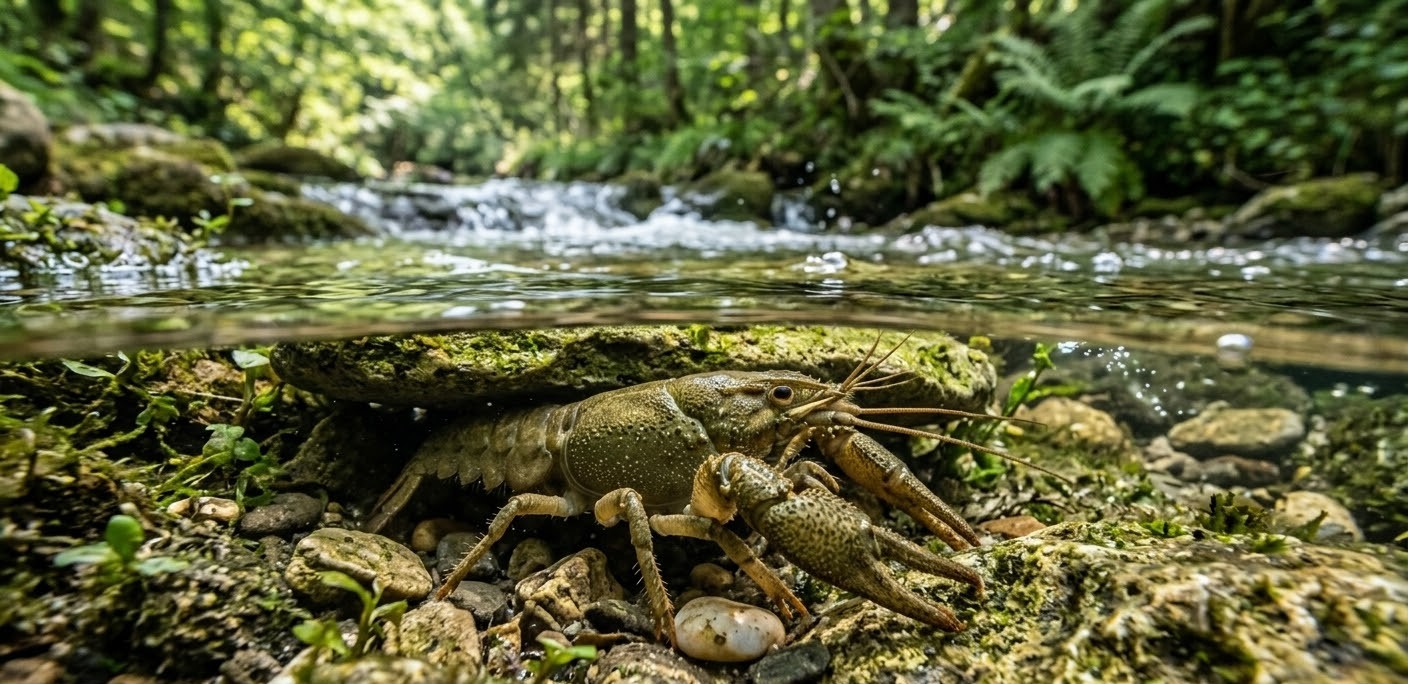
Biodiversity and Ecology: Small and Elusive
- Size: It is the smallest native crayfish species in Romania, rarely growing longer than 10-12 cm.
- Habitat: It prefers small, fast-flowing mountain streams, hiding under stones during the day. This is why it is called the "Stone Crayfish."
- Appearance: They have a dark brown or olive coloration that helps them blend perfectly with the riverbed.
- The Tail and the Curse: There is an old folklore saying in Bihor that crayfish look "broken" because they were cursed never to walk forward for stealing a saint’s coins. (Of course, scientists know they swim backward when scared!)
- Night Shift: They are primarily nocturnal. While hiking, you are unlikely to see them during the day unless you look closely under submerged rocks.
- Scientific Name: Austropotamobius torrentium.
- Status: It is a protected species under Romanian and European law. Catching or handling them without an expert guide is strictly forbidden.
- Where to find them: The purest streams in the Apuseni Mountains (especially in the Bihor karst areas like Padiș) and the Banat Mountains. Look for streams with a rocky bed.
FAQ: Understanding the Stone Crayfish (Racul Bihorean)
1. What exactly is a "Racul Bihorean"?
It is a species of freshwater crayfish, scientifically known as Austropotamobius torrentium. While found in several parts of Romania, it is a local icon in the Bihor and Apuseni regions, where it thrives in the cold, limestone-filtered mountain streams.
2. Can I eat this type of crayfish?
No. Unlike the common crayfish found in restaurants, the Stone Crayfish is a strictly protected species in Romania and across Europe. It is illegal to fish for them or consume them. Their value lies in their role within the ecosystem, not as food.
3. Why is it called a "bio-indicator"?
The Stone Crayfish is extremely sensitive to pollution. It can only survive in water that is chemically pure and rich in oxygen. If you see one in a stream, it is nature's way of telling you that the water is of the highest quality.
4. Where is the best place to spot one?
Look for shallow, fast-flowing mountain brooks in the Apuseni Mountains (see more), specifically in areas like Padiș or the Bihor Pass. They love hiding under flat stones or in submerged tree roots.
5. When are they most active?
They are nocturnal creatures. During the day, they remain hidden to avoid predators like trout or birds. If you want to see them, the best time is at dusk, though you must be very quiet as they are sensitive to vibrations.
6. Are they dangerous?
Not to humans. While they have pincers and will try to pinch if they feel threatened, they are small and much more afraid of you than you are of them. As a general rule for all mountain wildlife: look, but don't touch.
7. What should I do if I find one in a dried-up stream?
During very hot summers, some small streams might dry up. If you find a crayfish in a puddle that is disappearing, you can gently move it to the nearest permanent pool of the same stream, but always use wet hands or a clean container to avoid harming their delicate protective layer.
