
From Hobita to the World
Born in 1876 in the small village of Hobița, Gorj, Brâncuși grew up surrounded by the traditional woodcarving of the Romanian countryside. This rustic upbringing would later become the foundation of his world-famous art.
- The Journey: Legend has it that he walked nearly all the way from Bucharest to Paris in 1904 to pursue his dream.
- Refusing Greatness: He famously left Rodin’s studio after only two months, saying: "Nothing grows under the shade of great oaks." He needed his own sun.
The Philosophy of Essence
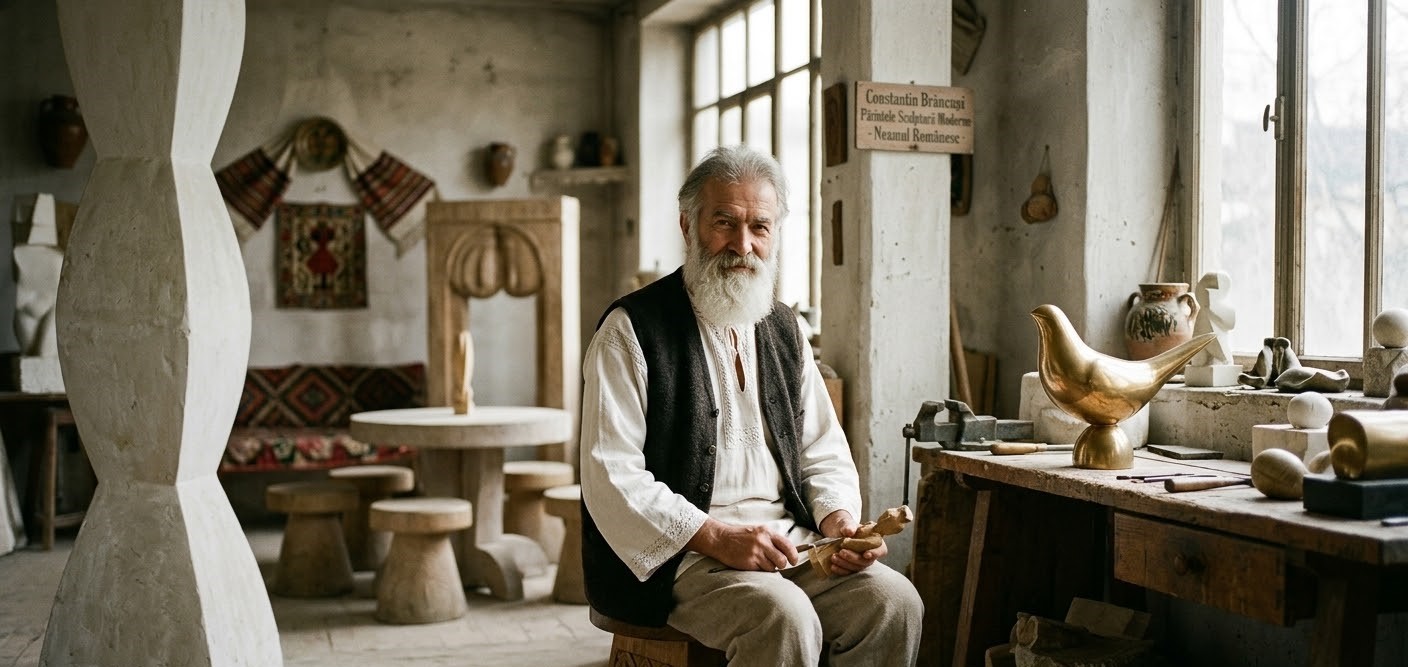
Brâncuși didn't just carve stone, bronze, or wood; he carved ideas. He wanted to find the "soul" of the objects he portrayed.
- Major Works: As we have explored on our forum, his masterpiece is the Ensemble in Târgu Jiu - The Endless Column (see more), The Gate of the Kiss (see more), and The Table of Silence (see more), created as a tribute to the heroes of World War I.
- The Bird in Space: Perhaps his most famous series, where he reduced the idea of flight to a single, perfect curve of polished bronze.
Even though he lived in Paris for most of his life, Brâncuși remained deeply Romanian. He wore traditional peasant clothes, hosted his friends with Romanian food and wine, and carved his furniture just like the craftsmen in Hobița. He died in 1957, leaving his studio to the French state, but his heart always belonged to the Romanian soil.
A personal tribute from Laurentiu, the admin:
FAQ: Constantin Brâncuși – The Visionary of Simplicity"In the name of the Romanian people, we thank you for the heritage you have left us and for contributing to the 'sculpting' of the Romanian soul. Your art is our eternal signature in the world."
1. Who exactly was Constantin Brâncuși?
Constantin Brâncuși was a Romanian sculptor who became one of the most influential artists of the 20th century. He is widely considered the "Patriarch of Modern Sculpture" because he moved art away from copying nature and toward capturing the inner essence of things.
2. Is it true he walked from Romania to Paris?
Yes, legend says that in 1904, due to a lack of funds but driven by immense ambition, he walked a significant portion of the journey from Bucharest to Paris. This legendary trek symbolizes his legendary determination and his "peasant strength."
3. Why are his sculptures so simple?
Brâncuși famously said: "Simplicity is complexity resolved." He didn't want to show how a bird looks on the outside, but the "feeling of flight" itself. By removing unnecessary details, he reached a pure, timeless form that speaks to everyone, regardless of their language or culture.
4. What is his connection to Romanian folklore?
Deep and unbreakable. Even in the middle of Paris, Brâncuși lived like a Romanian peasant. His most famous works, like the Endless Column, were directly inspired by the wooden pillars of peasant houses in his home region of Oltenia and the traditional motifs carved into village gates.
5. Why did he refuse to work with Auguste Rodin?
Rodin was the most famous sculptor at the time, and Brâncuși was his student for a short while. However, he left Rodin's studio because he believed that "nothing grows under the shade of great oaks." He knew he had to find his own unique path to greatness.
6. Where is the best place to experience his art?
While his works are in the world's greatest museums (MoMA New York, Pompidou Paris), the only place where you can see his art in its intended natural environment is the Târgu Jiu Ensemble in Romania. There, his masterpieces stand under the open sky, just as he envisioned them.
7. How do Romanians view him today?
For us, Brâncuși is more than an artist; he is a national hero. He represents the Romanian spirit: humble yet profound, deeply connected to the earth, but always reaching for the infinite.
