
The Scientific Breakthrough
- The Discovery: In 1916, Nicolae Paulescu succeeded in isolating a pancreatic extract that could lower blood sugar levels. He called it "Pancreine".
- The Research: Due to the chaos of World War I, he could only publish his extensive findings in 1921 in international scientific journals (Archives Internationales de Physiologie).
- The Nobel Controversy: In 1923, the Nobel Prize was awarded to Frederick Banting and John Macleod from Canada for the discovery of insulin. However, the international scientific community later acknowledged that Paulescu had described the effects of insulin and its potential for treating diabetes long before the Canadians.
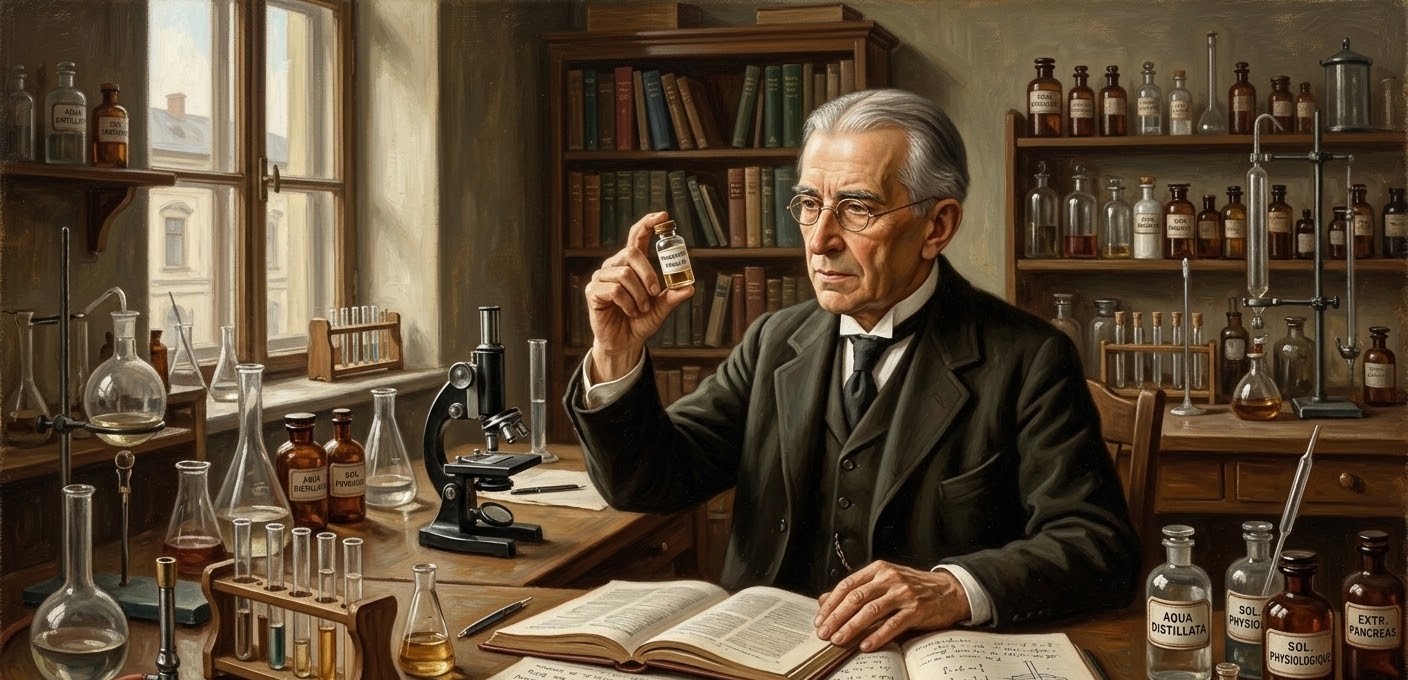
Life and Legacy
- Education: Born in Bucharest (1869), he studied medicine in Paris, where he obtained three doctorates (Medicine, Science, and Chemistry).
- Academic Career: He returned to Romania and became a professor at the Faculty of Medicine in Bucharest, where he dedicated his life to research and teaching.
- Ethics: Beyond his scientific work, he was known for his rigorous discipline and deep involvement in the medical community, leaving behind a legacy of hard work and intellectual brilliance.
Today, insulin is a fundamental treatment used by over 400 million people globally. Romania honors Nicolae Paulescu not just as a national hero, but as a universal contributor to human survival. His work at the laboratory in Bucharest paved the way for modern endocrinology.
Frequently Asked Questions: Nicolae Paulescu & The Discovery of Insulin
1. Who was Nicolae Paulescu?
Nicolae Paulescu (1869–1931) was a brilliant Romanian physiologist, professor of medicine, and research scientist. He is internationally recognized by the scientific community as the true pioneer in the discovery of insulin.
2. What did he actually discover?
In 1916, Paulescu succeeded in isolating a pancreatic extract that could lower blood sugar levels in diabetic subjects. He named this substance "Pancreine." Today, we know this substance as Insulin.
3. Why is there a controversy regarding the Nobel Prize?
In 1923, the Nobel Prize for Medicine was awarded to Frederick Banting and John Macleod (Canada). However, Paulescu had already published his successful results in August 1921, several months before the Canadians. It is considered one of the greatest oversights in the history of the Nobel Committee.
4. How did the scientific world react to this oversight?
In 1969, prof. Ian Murray, a prominent vice-president of the British Association of Diabetes, stated that "insufficient justice has been done to Paulescu" and that the Nobel Prize should have been shared with him. Since then, his role has been officially rehabilitated in medical textbooks worldwide.
5. Where did he conduct his research?
Most of his groundbreaking work was done at the Faculty of Medicine in Bucharest, Romania. Despite the hardships of World War I, he continued his laboratory experiments with very limited resources.
6. Is his legacy still visible in Romania today?
Absolutely. The National Institute of Diabetes, Nutrition, and Metabolic Diseases in Bucharest bears his name. Also, a prominent statue of Nicolae Paulescu stands in front of the Faculty of Medicine in Bucharest as a tribute to his life-saving work.
7. Was he involved in other scientific fields?
Yes, Paulescu was a polymath. He held doctorates in Medicine, Chemistry, and General Science from the University of Paris. He also made significant contributions to the study of the pituitary gland and the physiology of the spleen.
