
The Revolutionary Leader
Tudor was not just a soldier; he was a visionary who understood that the old Fanariot rule had to end for the country to breathe.
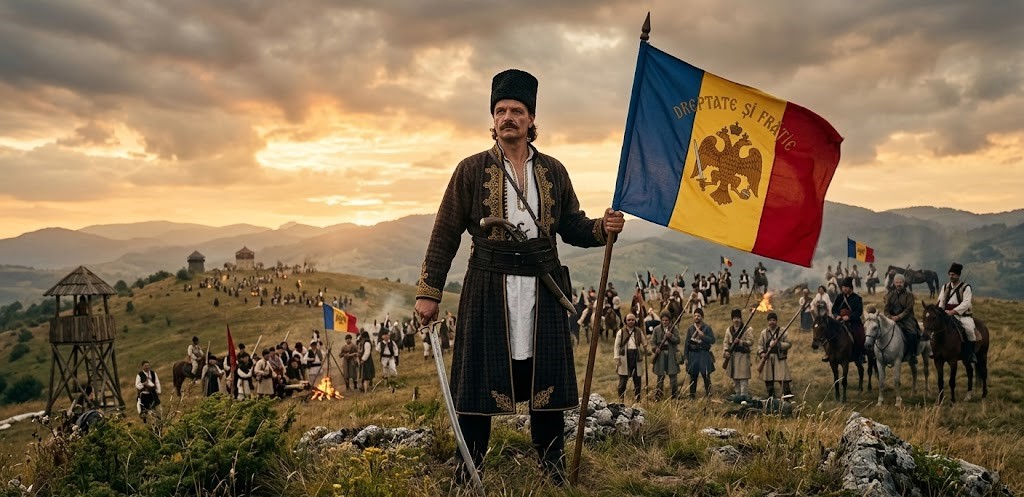
- The Pandurs: He organized and led an army of "panduri" (irregular soldiers), mostly peasants and small boyars, who saw him as their "Domnul Tudor" (Lord Tudor).
- The Padeș Proclamation: In 1821, he issued a powerful manifesto calling for the removal of corruption and the restoration of ancient rights, a document that acted as a spark for the national awakening.
- Military Skill: Before his revolution, he served as a lieutenant in the Russian army during the Russo-Turkish War (1806–1812), where he was decorated for his bravery with the Order of St. Vladimir.
His life and tragic end are woven into the fabric of Romanian identity.
- The Blue Flag: Tudor's revolutionary flag—featuring the icons of the Trinity and Saints—is considered a precursor to the modern Romanian tricolor.
- A Man of Honor: Legend says he never sought the throne for himself, but for the "justice of the people." His betrayal and execution by the Eterists did not stop the movement; instead, it ended the Fanariot era forever, bringing back native rulers.
- The Oltenian Hero: In his native region of Oltenia, he is still remembered in folk songs as a protector of the poor against the greedy "ciocoii" (corrupt landowners).
Fun Facts for History Buffs
- The Merchant Soldier: Before the revolution, Tudor was a successful merchant and a "vătaf" (administrator), showing he had both the mind for business and the heart for war.
- The Watchtower: He built and lived in fortified houses called "cule" in Oltenia, designed to withstand Ottoman raids.
- A Global Perspective: He spoke several languages and was aware of the democratic changes happening in Europe after the French Revolution, trying to align Romania with those modern ideals.
1. Who exactly was Tudor Vladimirescu?
Tudor Vladimirescu was a Romanian revolutionary leader, a former officer in the Russian army, and a small boyar (nobleman) from Oltenia. He led the 1821 Revolution, which sought to end the oppressive rule of the Phanariots (Greek administrators appointed by the Ottomans) and improve the lives of the peasantry.
2. What was the "Proclamation of Padeș"?
It was the official manifesto of the revolution, read by Tudor in January 1821. It was a revolutionary call to arms, stating that "justice and the law" should replace tyranny. It is often considered the first major step towards the modern Romanian Constitution.
3. What did the "Pandurs" represent?
The Panduri were a volunteer army of irregular soldiers, mostly composed of free peasants and small landowners from the Oltenia region. They were known for their bravery, their distinctive folk-style uniforms, and their unwavering loyalty to "Domnul Tudor."
4. How did Tudor Vladimirescu die?
His story is a tragic one. Due to complex political tensions and a lack of coordination with the Greek revolutionary secret society (Filiki Eteria), Tudor was kidnapped and executed by the Eterists in June 1821. Despite his death, his movement was successful in its primary goal: the Ottoman Empire finally stopped appointing Phanariot rulers and returned the thrones to native Romanian princes.
5. Why is he called "The Icon of Modern Romania"?
He is credited with "waking up" the national consciousness. Before him, resistance was mostly local or spontaneous. Tudor turned it into a national movement, bridging the gap between the suffering peasants and the reform-minded nobility.
6. Where can I see his legacy today?
- The "Cula" in Cerneți: You can visit his fortified house (tower-house) near Drobeta-Turnu Severin.
- Statues: Almost every major Romanian city has a street or a statue dedicated to him, the most famous being the monument in Bucharest (near the Cotroceni area).
- Romanian Banknotes: His portrait has appeared on various Romanian currency denominations over the years, cementing his status as a national hero.
