
A Relic of the Great Ice Age
While its "cousins" are common in the Ural Mountains and Central Asia, the Rock Onion in Romania is a glacial relic.
- The Great Escape: When the glaciers retreated thousands of years ago, this plant found a "micro-climate" on the sunny, steep cliffs of the Apuseni Mountains that perfectly mimicked its original home.
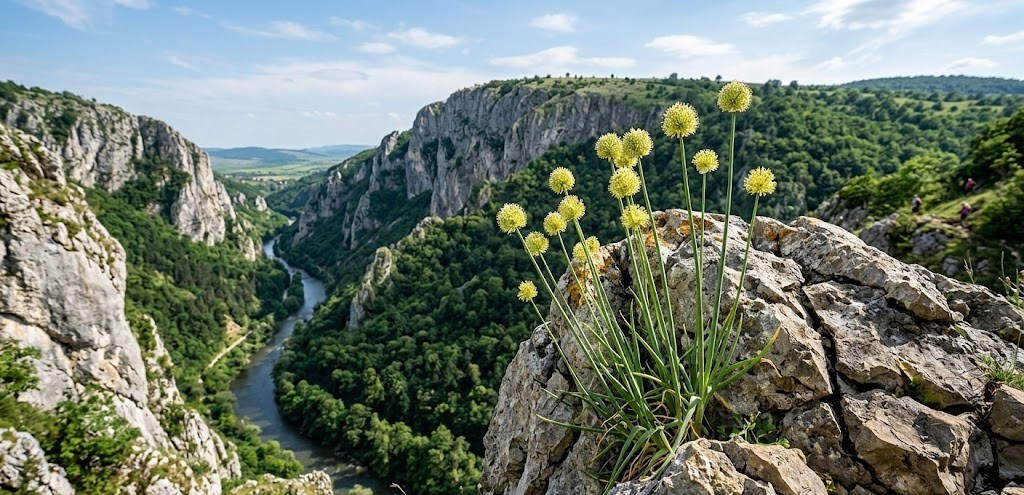
- Vertical Life: It doesn't grow in gardens; it clings to the dizzying heights of limestone walls, particularly in the Cheile Turzii (Turda Gorges) and Cheile Râmețului.
Botanical Identity
- Appearance: Unlike the common garden onion, the Rock Onion has a tall, elegant stem (up to 1 meter) and a globe-shaped inflorescence of small, pale yellow flowers.
- The Scent: If you crush its leaves, it releases a potent, classic onion-garlic aroma, a sign of its hardy nature.
- Strict Protection: It is a protected species in Romania, being extremely rare and vulnerable to climate changes.
Local shepherds in the Apuseni often tell stories of the "Golden Onion" that grows where only the eagles can reach. It was believed that those who could find and consume the Rock Onion would gain the strength of the mountain and be protected from the "evil eye." Because it grows on such steep cliffs, it became a symbol of purity and resilience—something beautiful that remains untouched by human hands.
Frequently Asked Questions
1. Where can I find the Rock Onion in Romania?
The best place to see it is in the Turda Gorges (Cheile Turzii) (see more) near Cluj-Napoca. It grows on the sunny, vertical limestone walls, often in places accessible only to professional climbers.
2. When does the Rock Onion bloom?
It typically blooms in June and July. During this time, its yellow spherical flowers stand out against the grey limestone of the gorges.
3. Can I eat it?
While it is technically edible and related to the common onion, it is strictly forbidden to pick or consume it. It is a critically endangered species in Romania, and harming even one plant carries heavy fines.
4. Why is it so rare?
It is a "geographic outlier." Its main population is thousands of kilometers away in the East. The Romanian populations are small, isolated "islands" of biodiversity that survived the warming of the planet after the Ice Age.
