
A Subterranean Reef in the Clouds
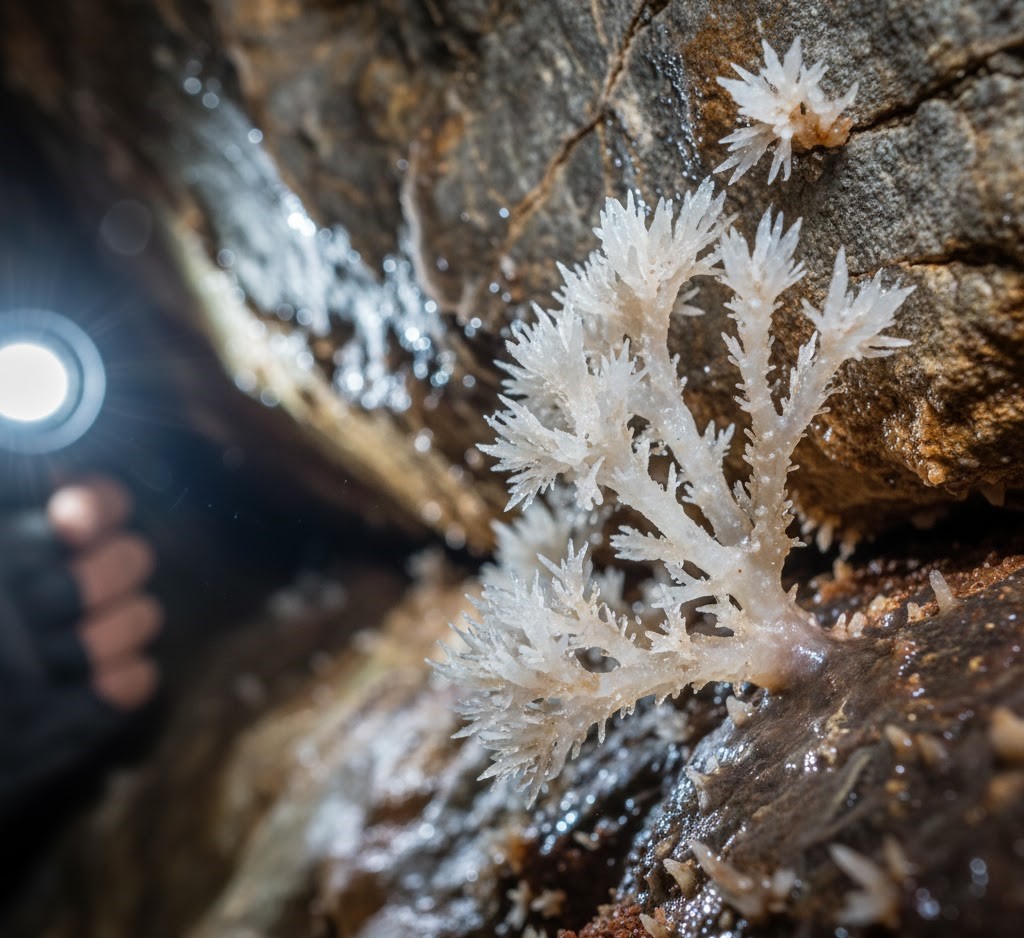
Discovered in 1971 by members of a local speleology club, this cave quickly became famous for its incredible speleothems (mineral deposits). Unlike typical caves that feature massive stalactites, the Coral Cave is filled with rare helictites and corallites.
These formations look like delicate branches of white or translucent coral, defying gravity by growing in all directions. Walking through the main gallery feels like walking through a frozen white garden, earning it the nickname "the jewelry box of the Vâlcan."
 Legends and Stories: The Treasure of the Lost Flowers
Because the cave was discovered relatively recently by modern explorers, its legends are tied to the local mining culture and the mysticism of the Jiu Valley:
-The White Garden of the Giants: Local folklore from the Jiu Valley tells of ancient giants who once lived in the mountains. Legend says they couldn't survive in the sunlight, so they tried to recreate the beauty of the flowery meadows underground. The "corals" are said to be the petrified remains of the white flowers they planted to keep their spirits happy.
-The Guardian of the White Stone: Early explorers spoke of a "hushing" sound deep within the narrow passages. Locals believed it was the mountain itself warning visitors to be careful—because the coral formations are so fragile, a single touch can destroy thousands of years of growth.
-The "Lungs" of the Mountain: Miners from the nearby areas once believed that certain caves in the region were connected to the very center of the earth, and the white minerals were the "salt of the earth" that kept the mountain air pure.
 Why It’s Unique
- Scientific Rarity: The coral-like formations are extremely rare in Europe and require a very specific microclimate and mineral concentration to form.
- Preservation: Because the cave is protected and access is somewhat restricted to preserve the delicate environment, it remains one of the cleanest and most intact caves in the region.
 Visitor Information
- Location: Near Câmpu lui Neag, at the end of the Jiu Valley.
- Access: The trail to the cave is steep and rewarding, offering great views of the Retezat and Vâlcan massifs.
- Pro Tip: This is not a "show cave" with paved paths and lights. You will need a helmet, a strong headlamp, and a guide or experienced caving partner.
 Frequently Asked Questions (FAQ) – The Coral Cave
1. Where is the Coral Cave located?
The cave is situated in the Vâlcan Mountains, near the village of Câmpu lui Neag, at the western end of the Jiu Valley (Hunedoara County). It is often a starting point for those heading towards the Retezat Mountains (Click HERE to see more).
2. Is the cave open to the general public?
The Coral Cave is a protected natural monument. While it can be visited, it is not a "show cave" with a ticket booth. Access is often restricted or regulated to protect the extremely fragile coral formations. It is best to visit with an authorized guide or as part of a speleological group.
3. Why is it called the "Coral" Cave?
The name comes from the rare corallite formations found inside. These are mineral deposits that branch out in every direction, looking exactly like white marine coral reefs.
4. How difficult is the hike to the cave?
The hike from the main road is relatively short but very steep. It takes about 45 to 60 minutes to reach the entrance from the Scorota Valley area. You will need sturdy hiking boots and a good level of fitness.
5. What equipment do I need?
Unlike Valea Cetății, this cave has no artificial lighting or walkways. You MUST have:
- A professional headlamp (and a backup).
- A helmet (the ceiling is low and uneven).
- Protective clothing (it’s muddy and the temperature is around 8 degrees C
The main gallery is accessible, but the cave is narrow and can be slippery. The biggest "danger" is actually to the cave itself—the formations are so delicate that even a slight brush with a backpack can break a thousand-year-old crystal. Extreme care is required.
7. Can I take pieces of "coral" home as a souvenir?
Absolutely not. Taking anything out of the cave is illegal and causes irreparable damage to Romania's natural heritage. The motto here is: "Take nothing but pictures, leave nothing but footprints."
