
A Hybrid of Nature and Legend
The name "Baia" (an archaic Romanian term for "mine") suggests that this site was known to the German miners (Saxons) who explored these mountains centuries ago in search of precious metals. It is a place where the boundary between a natural cavern and an ancient mine gallery feels blurred.
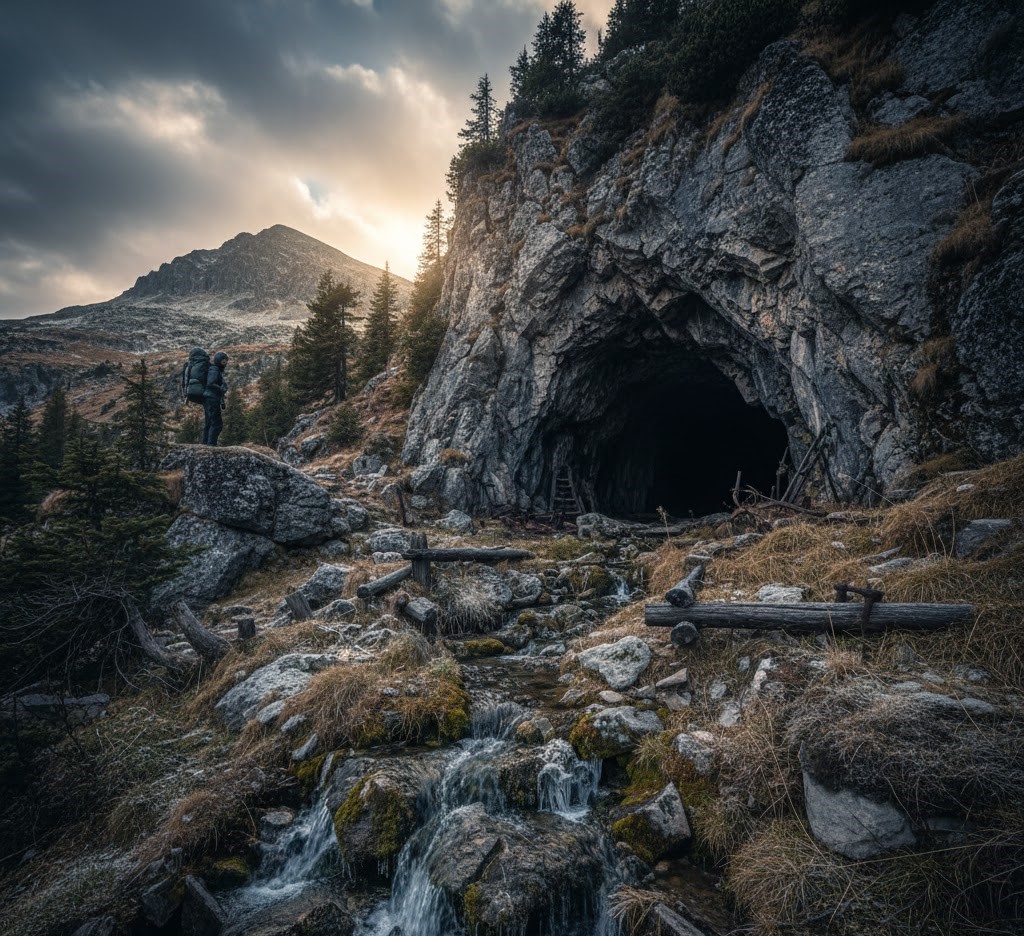
 Baia lui Schneider: The Alchemist's Mine
1. The Legend of the German Miner (Schneider)
The Legend: Who was Schneider? The Story: Local tradition says that Schneider was a master miner brought from Saxony (Silezia) centuries ago to extract the precious ores of the Rodna Mountains. Legend has it that he wasn't just a miner, but a bit of an alchemist. It is said he discovered a vein of "living silver" deep inside the mountain that could grant long life. Though he vanished mysteriously, the cave-mine kept his name, and some say his "spirit light" (a faint glow) can still be seen deep in the galleries when the moon is full.
2. The Cave of 1,000 Tools
The Legend: The tools that turned to stone. The Story: Because this was a place of intense labor, folklore says that when the miners were forced to abandon the site due to a great collapse or plague, they left behind all their gear. The legend tells that over hundreds of years, the mountain "swallowed" the iron hammers and chisels, turning them into stalactites and stalagmites. People believe that if you find a rock shaped like a tool, it will bring you luck in finding your own "inner gold."
3. The Portal to the Rodna Depths
The Legend: A shortcut through the mountain. The Story: Miners often whispered that Baia lui Schneider wasn't just a dead-end tunnel, but part of a much larger, secret network of caves that crosses the entire Rodna range. It was believed that the "Mountain King" allowed the miners to take the ore as long as they never tried to find the central chamber where the mountain's heart beats.
Why It’s Special
- High Altitude: It is one of the highest caves in the massif, located in a spectacular alpine setting.
- Traces of Exploration: Inside, explorers have found old wooden structures and marks left by miners from centuries past, making it a "time capsule" for the mining history of the Rodna Mountains.
- Technical Terrain: Like most caves in this range, it’s not a walk in the park. It features vertical drops and narrow passages that require specialized caving skills.
The cave is situated in one of the most beautiful areas of the National Park. After exploring (or reading about) the depths of Baia lui Schneider, hikers are just a stone's throw away from the turquoise waters of Lala Lakes and the majestic pyramidal shape of Ineu Peak (2,279m).
A video from inside Baia lui Schneider Cave (Pestera Baia lui Schneider):
Frequently Asked Questions: Baia lui Schneider (FAQ)
1. What does "Baia lui Schneider" mean?
The name "Baia" is an old Romanian/Transylvanian term for "mine." Schneider is a German name, likely belonging to a Saxon mining master. Therefore, the name translates to "Schneider’s Mine," reflecting the deep history of mineral exploration in the Rodna Mountains.
2. Where is Baia lui Schneider cave located?
The cave is situated in the eastern part of the Rodna Mountains National Park, close to the Ineu Peak and the Lala Glacial Lakes. It is located at a high altitude, making it one of the most alpine caves in the region.
3. Is Baia lui Schneider a natural cave or a man-made mine?
It is a hybrid. While the core of the cavern is a natural karstic formation, it was historically used and extended by miners looking for precious metals. Inside, you can still find traces of old mining activities alongside natural limestone formations.
4. Is Baia lui Schneider open to tourists?
The cave is not officially "arranged" for mass tourism (no lights or stairs). While it doesn't have the same strict scientific restrictions as Tăușoare, it is dangerous for beginners. Entry requires specialized caving equipment, helmets, and powerful lighting.
5. What can you see inside Baia lui Schneider?
Visitors can see a mix of natural cave passages and historical mining remnants. Because of its high altitude, the cave environment is very cold and rugged, often holding ice or snow near the entrance even into late spring.
6. How do I get to the cave?
The most common route starts from the Pasul Rotunda or from Gura Lalei, following the trails toward Ineu Peak. It is a demanding hike that rewards you with some of the best views in the Eastern Carpathians.
