
The Legend and Folklore
In Romanian rural traditions, the praying mantis is often viewed with a mix of respect and superstition.
- The Silent Nun: The name "Călugărița" reflects its calm, stoic appearance. Old village stories suggest that seeing a mantis is a sign of good luck or a reminder to stay patient.
- The Guiding Spirit: In some regions, it was believed that if a traveler was lost, the mantis would "point the way" with its long front legs.
- The Symbol of Vengeance: Due to the female's famous habit of cannibalizing the male after mating, the insect is sometimes seen as a symbol of cold, calculated power in local tales about "nature's justice."
Biodiversity and Habitat
The European Mantis is a vital part of Romania's ecosystem, acting as a natural pest controller.
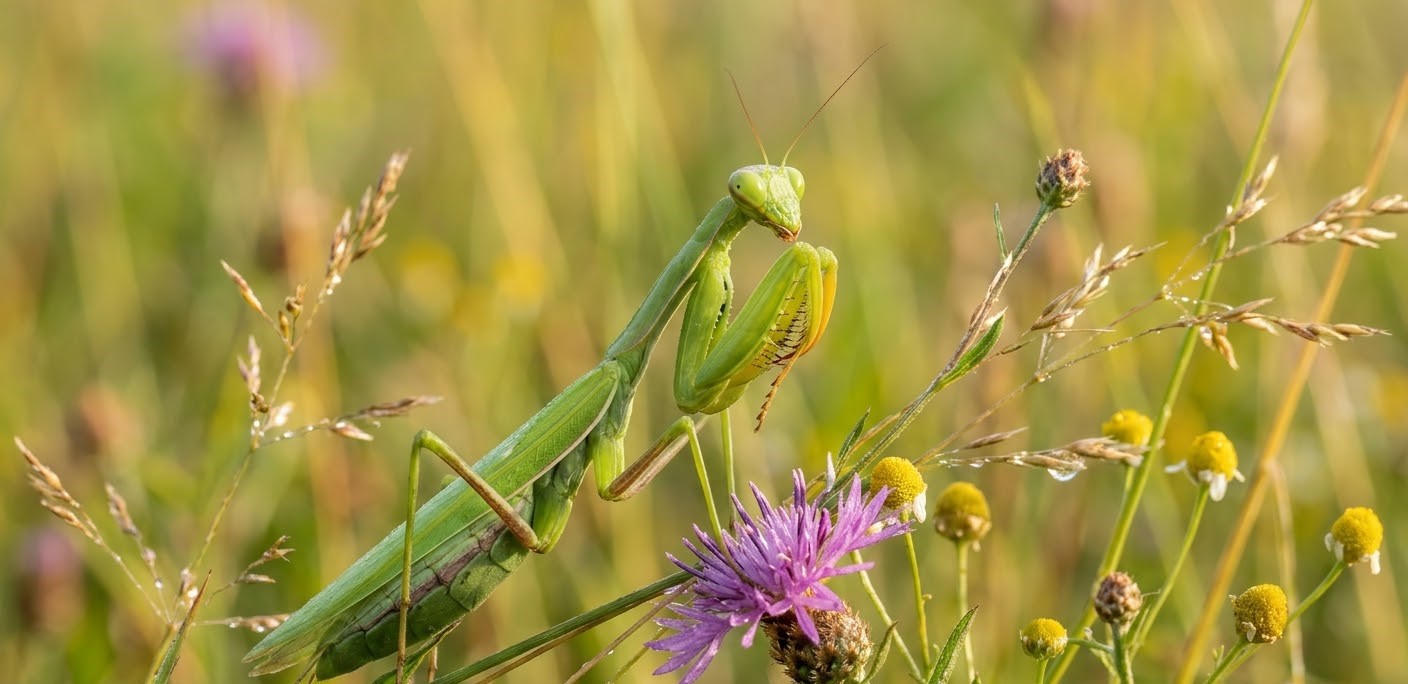
- Habitat: You can find them across Romania, from the lowlands of the Bărăgan Plain to the sunny slopes of the Sub-Carpathians. They thrive in dry, warm meadows with tall grass and shrubs.
- Master of Camouflage: Their color can range from vibrant green to straw-yellow or brownish-grey, depending on the environment they inhabit. This allows them to blend perfectly with the vegetation.
- Diet: They are apex predators of the insect world, feeding on flies, grasshoppers, and even larger prey. Their lightning-fast strike—one of the fastest movements in the animal kingdom—makes them highly efficient hunters.
- Size: Females are significantly larger, reaching up to 7-9 cm, while males are smaller and more slender.
- Vision: They are the only insects known to have 3D vision. Their large, compound eyes are set on a highly mobile triangular head that can rotate 180°, allowing them to scan their surroundings without moving their bodies.
- Life Cycle: In late autumn, the female lays her eggs in a protective, foam-like case called an ootheca, which hardens to protect the eggs through the cold Romanian winter.
- A Protected Guest: While not endangered globally, the European Mantis is a protected species in several European countries and is highly valued by Romanian gardeners for eating harmful insects without damaging plants.
- Ear on the Belly: Interestingly, the mantis has a single ear located on its abdomen, which it uses to detect the ultrasonic signals of bats—its primary nocturnal predator.
- The "Black Spot": A key identification feature of Mantis religiosa is a black spot (often with a white center) located on the inside of its front coxae (the "armpit" area).
FAQ: European Mantis (Călugărița) - The Silent Predator
Q: Why is it called "Călugărița" in Romanian?
A: The name translates to "The Little Nun." This is due to the insect's resting position, with its front legs folded together as if in prayer, resembling the stoic and calm posture associated with monastic life.
Q: Is the European Mantis dangerous to humans?
A: Not at all. They do not have venom and are not aggressive toward humans. While a large female might give a tiny pinch if handled roughly, they are completely harmless and actually beneficial to have in a garden.
Q: Does the female always eat the male after mating?
A: While this behavior (sexual cannibalism) is famous, it doesn't happen every time. In the wild, it occurs in about 15% to 30% of cases. It is more common when the female is particularly hungry, as the male provides essential nutrients for the development of the eggs.
Q: What do they eat in the Romanian meadows?
A: They are strictly carnivorous. Their diet consists mostly of other insects like grasshoppers, flies, moths, and crickets. Because they eat pests that destroy crops, they are considered a "natural pesticide" by Romanian farmers.
Q: Can they fly?
A: Yes, but with some differences between the sexes. Males are smaller and are quite capable flyers, often flying at night to find mates. Females are much heavier and, while they have wings, they rarely fly long distances, preferring to stay camouflaged in the tall grass.
Q: How do they survive the cold Romanian winters?
A: The adult mantises usually die when the first hard frosts arrive in late autumn. However, they leave behind an ootheca—a protective, papery egg case attached to a twig or stone. The eggs inside are perfectly insulated and hatch when the weather warms up in late spring.
Q: Where is the best place to spot one?
A: Look for them in sunny, un-mowed meadows or gardens with tall vegetation, especially in the southern and western regions of Romania (like the Bărăgan or Banat plains) during August and September.
