
The Legend of the Infinite Wine
While history tells of the village's prosperity through trade and salt, local folklore whispers of a different secret. Legend has it that in the old days, the cellars were so interconnected that a man could enter a door at one end of the village and emerge at the other without ever seeing the sun—all while being treated to a glass of wine at every stop.
It was said that the underground network was so vast that it acted as a "silent city" where villagers would hide their most precious possessions and spirits during times of invasion. The "magic" of Sălacea is believed to reside in the earth itself; the local soil is said to "protect the soul of the grape," ensuring that wine stored here never truly loses its youth.
Biodiversity and the "Valley of the Jer"
The landscape of Sălacea is not just about human architecture; it is defined by its natural surroundings:
- The Rolling Hills: The geography is dominated by gentle loess hills, which provide the perfect insulation for the cellars.
- Flora: Around the village, you can find traditional orchards and ancient grape varieties like Bakator, a rare type of grape that is being revived by local enthusiasts.
- The Wetlands: Nearby, the Jer Valley (Valea Ierului) offers a unique ecosystem of wetlands and reeds, home to various species of water birds and rare amphibians, making it a peaceful contrast to the structured vineyard hills.
For the curious traveler, the "Thousand Cellars" are a feat of traditional engineering:
- The Number: There are actually approximately 970 cellars concentrated along a single street (Valea Pivnițelor).
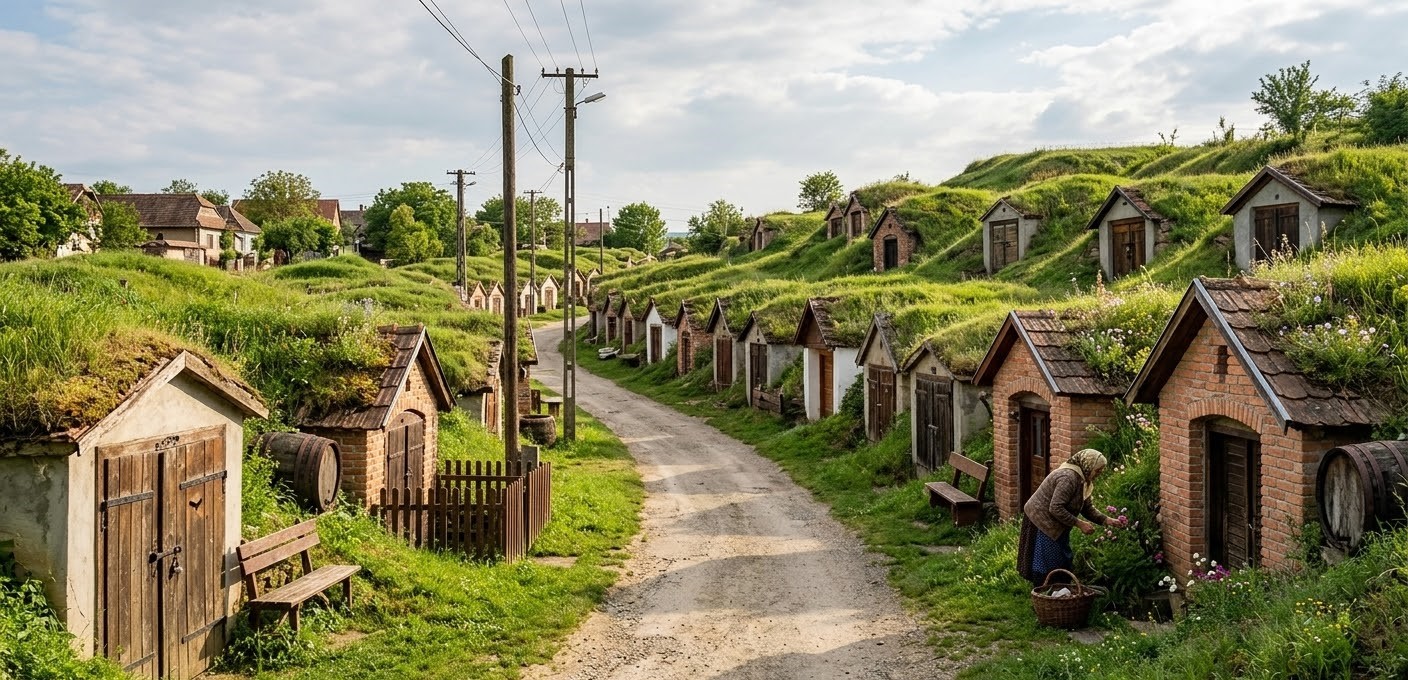
- Construction: The cellars are dug directly into the loess (clay-like soil) hills. They are reinforced with brick or stone facades, many featuring ornate doors and traditional family crests.
- Climate Control: Due to being buried in the earth, the cellars maintain a constant temperature of 10°C to 12°C year-round, regardless of the scorching summer heat or freezing winter.
- The Oldest Cellar: Some of these structures date back to the 18th century, with the oldest being recorded around 1743.
- More Doors than Houses: In some parts of the village, there are actually more cellar doors visible from the street than there are residential front doors!
- The "Hobbit" Aesthetics: To a foreigner, Sălacea often looks like a real-life Shire. The grass-covered mounds with small wooden doors built into the hillside have earned it comparisons to J.R.R. Tolkien’s Middle-earth.
- A Cultural Crossroads: Sălacea is a beautiful example of the multicultural history of Bihor, where Romanian and Hungarian traditions in winemaking and architecture have blended for centuries.
FAQ: Sălacea (Sălacea) - The Village of a Thousand Cellars
Q: Where exactly is Sălacea located?
A: Sălacea is situated in Bihor County, in the northwestern part of Romania, within the historical region of Crișana. It is about 50 kilometers north of the city of Oradea.
Q: Are there really a thousand cellars?
A: Almost! There are nearly 970 traditional wine cellars concentrated along a single street, known as Cellar Street (Valea Pivnițelor). It is one of the highest concentrations of such structures in Europe.
Q: Can I actually enter and visit the cellars?
A: Many of the cellars are private property, passed down through generations. However, during local festivals or by pre-arranging a visit with local guesthouses, many owners are happy to open their doors for a tour and a wine tasting.
Q: What kind of wine is produced here?
A: The region is famous for its white wines. A local specialty being revived is the Bakator grape, alongside more common varieties like Riesling and Fetească Regală. The loess soil gives the wine a distinct, mineral character.
Q: Is there a "best time" to visit the village?
A: While the cellars are picturesque year-round, late spring and summer are best for seeing the hills in their vibrant green "Hobbit-style" glory. Autumn is also fantastic for experiencing the harvest season and tasting fresh must or wine.
Q: Why were the cellars built outside the houses?
A: The cellars were dug into the hillsides because the loess soil provides a perfect, natural insulation. Building them outside the main living areas allowed villagers to utilize the natural geography for large-scale storage without taking up space in their residential yards.
Q: What else can I see in Sălacea?
A: Besides the cellars, you can visit the Roman Catholic Church (built in 1792), the Reformed Church, and the nearby Jer Valley nature reserve, which is a paradise for birdwatchers.
