
The Legend of the Outlaw Ionele
The cave's name is deeply rooted in local folklore and the mysterious figure of an outlaw. Legend has it that the cave served as a hiding place for a young man named Ionel. He reportedly took refuge here to escape the authorities (the potera) who were hunting him.
It is said that his lover brought him food to the mouth of the cave every evening, but the authorities eventually managed to follow her in secret. Thus, the outlaw was captured right inside this immense portal. Locals still believe that the spirit of his freedom haunts the high galleries, and the echo of water droplets sometimes sounds like the footsteps of someone hiding in the darkness.
Biodiversity: The Bat Kingdom
Poarta lui Ionele Cave is a site of major ecological importance and was declared a Natural Monument in 1999.
- The Bat Colony: The upper gallery (Polaris Gallery) houses a permanent colony of bats. For this reason, tourist access to this section is strictly forbidden to avoid disturbing these nocturnal creatures, which are essential to the ecosystem.
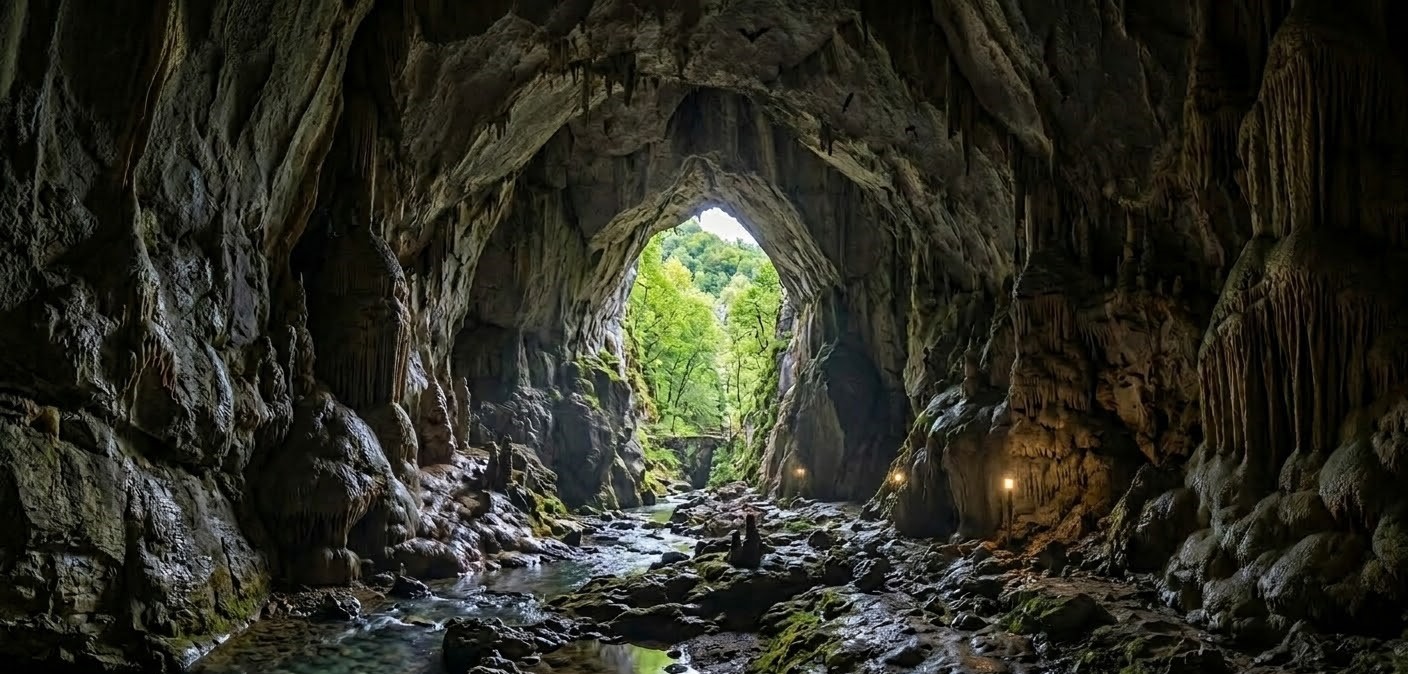
- Karst Flora: High humidity and the limestone substrate favor the growth of rare moss and fern species at the cave's entrance, creating a superb color contrast with the whitish rock.
- Specific Microorganisms: As an active cave (through which water flows), the subterranean fauna includes small crustaceans and troglobitic insects that live exclusively in caves.
- Altitude: 810 meters above sea level.
- Length: Approximately 131 meters (accessible part).
- Entrance Portal: Stands at an impressive height of over 12–15 meters, being one of the largest cave entrances in Romania.
- Hydrological System: The cave is the point where waters lost in the sinkholes of Valea Oarbă emerge. In spring, during the snowmelt, a temporary lake and a spectacular waterfall form inside.
- Facilities: It is electrically lit and equipped with metal stairs and bridges, making it very safe for visitors of all ages.
- The Ice Castle: During freezing winters, ephemeral ice stalagmites and stalactites form at the entrance, turning the portal into a true "crystal palace."
- Special Acoustics: Due to its giant vaulted shape, the acoustics are phenomenal. Occasionally, local folk music groups use the space to demonstrate the unique sound of the tulnice (Carpathian horns).
- Famous Neighbors: It is located just a few kilometers from the famous Scărișoara Ice Cave, often serving as the first stop on the trail toward the glacier.
FAQ: Poarta lui Ionele Cave (Peștera Poarta lui Ionele)
Q: Where exactly is Poarta lui Ionele Cave located? A: It is situated in the Apuseni Mountains (see more), specifically in the Ordâncușa Gorges (Cheile Ordâncușei), Gârda de Sus commune, Alba County.
Q: How do I get to the cave? A: Access is very easy. You can drive from the center of Gârda de Sus following the paved road through the Ordâncușa Gorges for about 2.5 kilometers. There is a small parking area near the entrance.
Q: Is the cave difficult to visit? A: Not at all. It is one of the most "tourist-friendly" caves in the region. It features metal walkways, stairs, and electrical lighting, making it accessible for families with children and seniors. The visit usually takes about 20 minutes.
Q: When is the cave open for visitors? A: Generally, it is open daily during the summer season (May–September). During the off-season, hours may vary or it may be closed during heavy snow. It is always best to check locally in Gârda de Sus before heading up.
Q: Is there an entrance fee? A: Yes, there is a small maintenance fee (usually around 10–15 RON). The funds go toward the preservation of the site and the electricity for the interior lighting.
Q: Why is part of the cave closed to the public? A: The upper gallery, known as the Polaris Gallery, is a protected sanctuary for a colony of rare bats. To protect their habitat and prevent disturbing their hibernation or breeding cycles, this area is strictly off-limits to tourists.
Q: What else can I see nearby? A: The cave is part of a "natural circuit." Just a few kilometers further up the mountain is the world-famous Scărișoara Ice Cave (Ghețarul de la Scărișoara). You can also explore the many hiking trails and traditional wooden houses of the Moți people in the surrounding villages.
