
Biodiversity: The Real Bird Behind the Legend
Setting literature aside, the real hoopoe (Upupa epops) is a fascinating bird:
- Distinctive Appearance: It is unmistakable with its elegant fawn-colored body, dramatic black-and-white striped wings and tail, and a spectacular erectile crest that it raises when excited or landing.
- Habitat: It prefers open, sun-dappled environments: old orchards, pastures, and—just like in Creangă's tale—light woodlands with mature trees like linden tree (see more) and oak, where it searches for insects in the hollows.
- The Infamous Defense: While not mentioned by Creangă, the hoopoe has a famous defense mechanism: both chicks and females can spray a foul-smelling liquid from an oil gland to deter predators, making their nesting hollows... less than pleasant. This is where the saying "foul as a hoopoe" likely comes from.
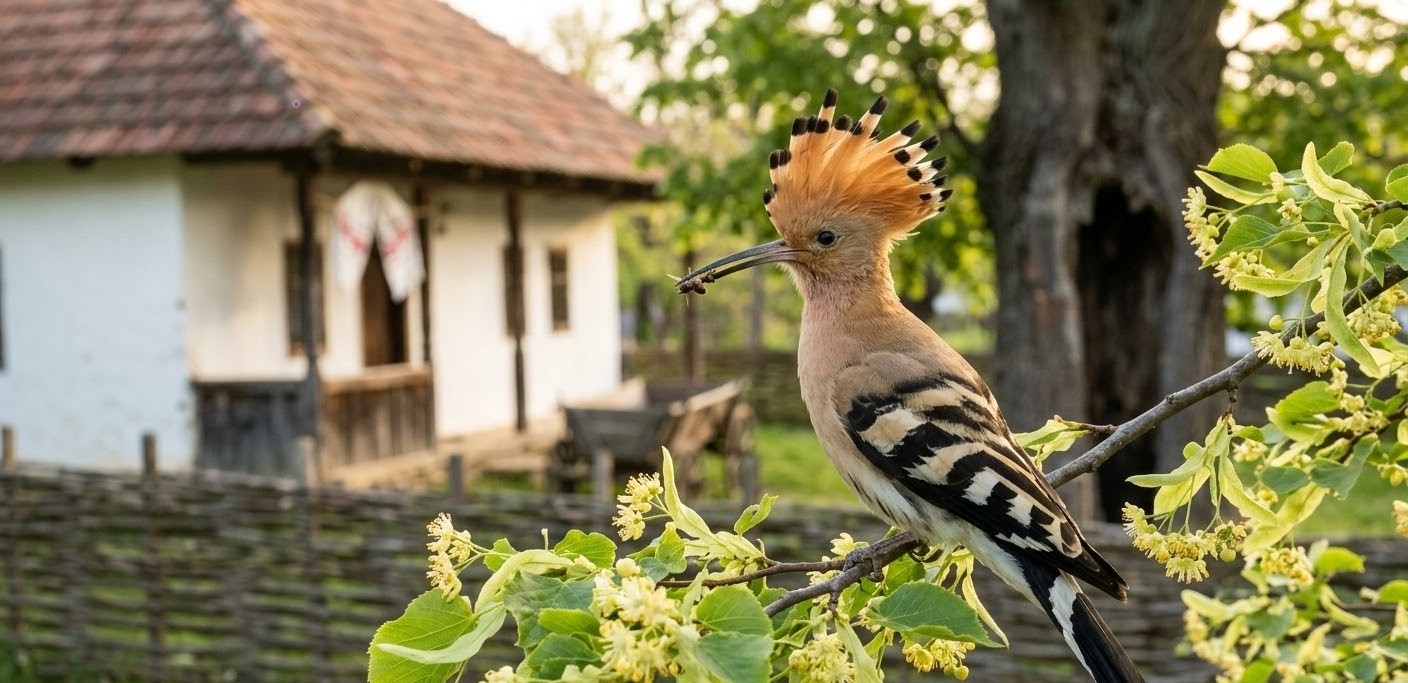
The Legend of The Hoopoe in the Linden Tree "Pupăza din Tei": Ion Creangă's Playful Muse
If you mention the hoopoe to any Romanian, the first thing they will think of is "Pupăza din Tei", a phrase immortalized by Ion Creangă (see more) in his "Amintiri din copilărie" (Childhood Memories).
-The Stolen Wakener: In Creangă's story, the mischievous young narrator (Smărăndița's son, Nică) is exasperated by the hoopoe’s persistent early morning calls. It wasn't the beautiful song that annoyed him, but its role as the village "alarm clock," waking everyone up far too early to work in the fields.
-The Hilarious Plot: Fed up with the noise, Nică decides to steal the bird from its nest inside a hollow linden tree (tei), intending to sell it at the market. The comical chaos that follows, including his attempts to hide the bird from his mother, has made this episode one of the most beloved in Romanian literature.
-Symbol of Childhood: The "Pupăza din Tei" represents the rebellious spirit and humorous innocence of Ion Creangă's idealized rural childhood. To this day, the bird is sometimes affectionately (or mockingly) called "Smărăndița's alarm" in references to the tale.
Fun Facts for the Curious Mind
- Crepe, Crepe!: In Romanian, the bird is called 'pupăză,' which is onomatopoeic, reflecting its soft, repetitive "pu-pu-pu" call. Ion Creangă often described it as a annoying "pup-up-up" sound that signaled the start of backbreaking field work.
- International Fame: While a star in Romanian tales, the hoopoe has international renown; it was the national bird of Israel and even appeared in ancient Egyptian hieroglyphs.
- Migration Mystery: Hoopoes are migratory, spending the winter in Africa and South Asia, and returning to Romania in the spring, often coinciding with the first warming days of linden tree blossoms.
FAQ: Everything About the Hoopoe (Upupa epops)
1. What makes the hoopoe look so unique?
The hoopoe is famous for its erectile crest (a crown of feathers) that it opens like a fan when it is excited or when it lands. It has a long, thin, curved beak used for probing the ground for insects and striking black-and-white striped wings that look like a giant butterfly when in flight.
2. Is the hoopoe a migratory bird in Romania?
Yes, the hoopoe is a migratory species. It arrives in Romania in early April to breed and stays until late August or September, when it migrates to Africa (south of the Sahara) or Southern Asia to spend the winter in warmer climates.
3. What do hoopoes eat?
They are primarily insectivores. Using their specialized beaks, they hunt for larvae, crickets, beetles, and spiders hidden in the soil or under decaying wood. They are very beneficial for farmers because they eat many agricultural pests.
4. Why is the hoopoe's nest known for being "smelly"?
The hoopoe has a unique (and stinky) defense mechanism. The female and the chicks can produce a foul-smelling liquid from a specialized gland. They spray this liquid to deter predators like snakes or cats. This is why their nesting hollows often have a very strong, unpleasant odor.
5. Where do they usually build their nests?
Hoopoes are cavity nesters. They don't build traditional nests out of twigs on branches; instead, they look for hollows in old trees (like linden, oak, or fruit trees), holes in vertical earthen banks, or even gaps in old stone walls and abandoned buildings.
6. Does the hoopoe have a specific song?
The bird’s name in many languages (including the Romanian pupăză) is onomatopoeic. Its call is a soft, low-pitched, and repetitive "pu-pu-pu" or "oop-oop-oop", which can be heard from a great distance across the meadows.
