
Biodiversity: Life in the Dark
Despite the lack of light, Găunoasa is a sanctuary for unique life forms:
- The Bat Colonies: It serves as an important hibernation spot for several protected bat species. They are vital for the local ecosystem, keeping the insect population in check.
- Cave Insects: Look closely at the walls, and you might see rare, eyeless insects that have evolved over millennia to live in total darkness.
- Microscopic Wonders: The cave walls are often covered in "moonmilk" (a soft, white limestone deposit) that hosts specialized bacteria.
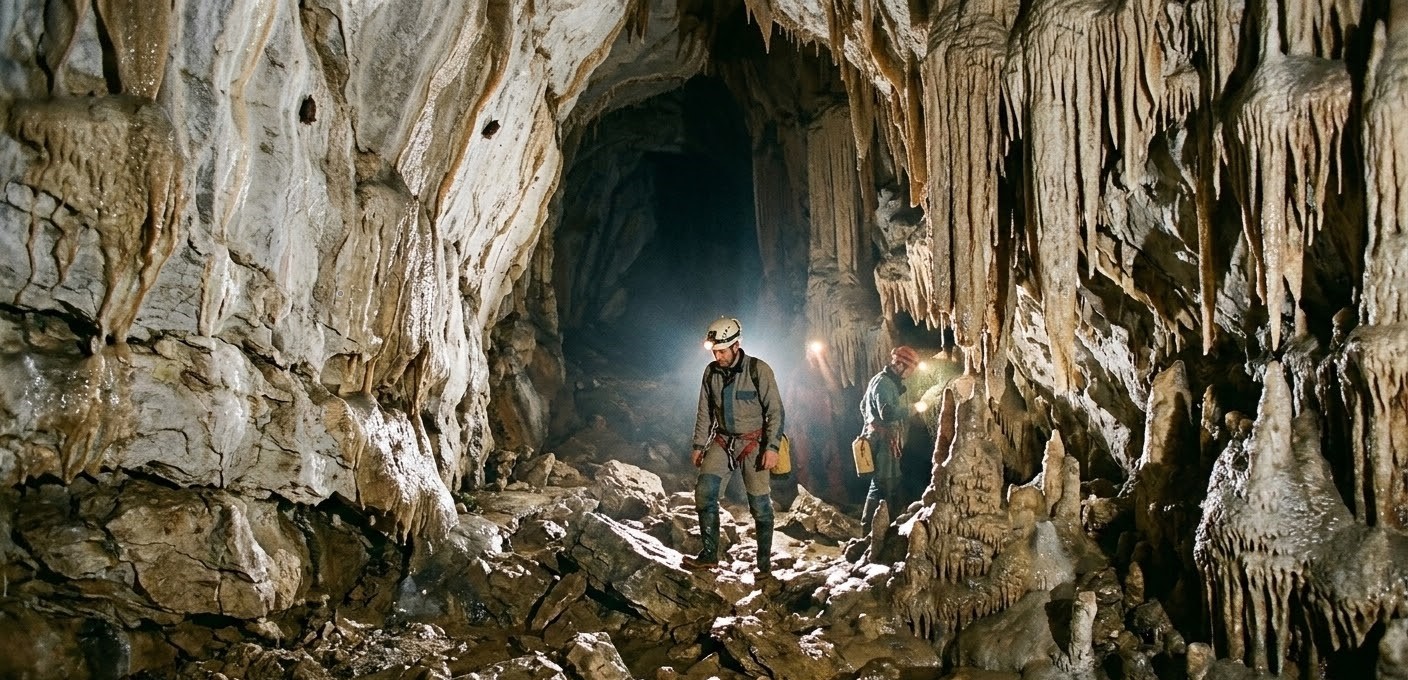
Legends & Local Mysteries: The Whispering Earth
Local legends in the area of the Șureanu Mountains often speak of hidden dacian treasures buried deep within these limestone formations. Some say the name "Găunoasa" (meaning "hollowed" or "gaping") refers to the way the mountain "breathes" during winter, with steam rising from the cave mouth, leading ancestors to believe it was a portal to a subterranean world.
Technical Overview:
- Total Length: It has a development of approximately 200 to 250 meters. It is classified as a small-to-medium-sized cave.
- Structure: While the entrance is fairly spacious and "airy," the galleries become more technical as you move deeper. The cave ends somewhat abruptly in areas of collapsed rock or very narrow passages (crawls).
- Concentrated Beauty: Because it is a "fossil cave" (meaning there is no permanent active river flowing through it now), the limestone formations are densely packed. You don't have to walk for miles to see stunning stalactites; they are visible almost immediately.
Is it just an arch or a real cave?
Most videos show the spectacular limestone arch at the entrance, which acts like a massive natural portal. However, the true Găunoasa Cave begins behind this arch. As you move past the daylight zone, the path leads you underground into a series of dark, silent galleries filled with ancient mineral formations. It’s a transition from a scenic "stone window" to a genuine subterranean world.
Fun Facts for the Curious Traveler
- A Natural Laboratory: For speleologists (cave scientists), Găunoasa is a treasure trove of information about how the climate of the region has changed over thousands of years, recorded in its stalactites and stalagmites.
- Connection to Cioclovina: Many experts believe there are hidden, underwater galleries connecting Găunoasa to the larger Cioclovina system, though many remain unexplored.
- Total Silence: Once you move deep enough inside, the silence is so absolute you can hear your own heartbeat—an experience many travelers find both eerie and meditative.
When exploring Peștera Găunoasa, or any wild cave in Romania, remember the golden rule of speleology: "Take nothing but pictures, leave nothing but footprints, kill nothing but time."
- Do Not Touch the Formations: Even a single touch can transfer oils from your skin to the stalactites and stalagmites. This oil creates a waterproof barrier that stops the limestone from growing, effectively "killing" the formation forever.
- Respect the Residents: If you see bats, keep your distance, lower your voice, and never shine your light directly at them. Waking them during hibernation can cause them to burn through their fat reserves, which is often fatal.
- Keep it Clean: Caves do not have a natural way to decompose trash. Even organic waste (like a banana peel) can introduce bacteria that disrupt the entire subterranean ecosystem.
FAQ: Exploring Găunoasa Cave (Hunedoara)
1. Is Găunoasa Cave a "tourist" cave?
No, Găunoasa is a "wild" cave, meaning it does not have artificial lighting, paved walkways, or railings. It is preserved in its natural state, making it ideal for adventurous travelers who prefer exploring untouched environments rather than commercial sites.
2. Do I need a guide to visit?
While the entrance area can be reached by most hikers, exploring the interior galleries is strongly recommended only with a specialized guide or as part of an organized speleology group. The terrain inside can be disorienting and slippery.
3. What equipment is mandatory for entry?
To visit safely, you must have:
- A helmet (to protect against low ceilings and falling debris).
- Two independent light sources (a headlamp and a powerful flashlight as backup).
- High-grip waterproof boots, as the cave floor is often damp or muddy.
- Warm clothing, as the temperature inside stays around 10°C year-round.
The cave can be visited year-round, but late spring and autumn are best for the hike through the Luncani-Piatra Roșie Nature Park. During winter, be mindful that the cave is a hibernation site for bats; it is important to keep noise and light to a minimum to avoid disturbing them.
5. How do I get to the cave?
The cave is located near the village of Cioclovina (see more). Access is usually via a hiking trail from the Luncani area. The path involves a moderate hike through the forest, so ensure you have a GPS map or a local guide, as mountain signs in this remote part of the Șureanu Mountains can be sparse.
6. Are there other attractions nearby?
Yes! The area is rich in history and nature. You can combine your visit with the Cioclovina Cave, the Dacian Fortress of Piatra Roșie (a UNESCO World Heritage site), and the stunning meadows of the Șureanu Mountains.
