
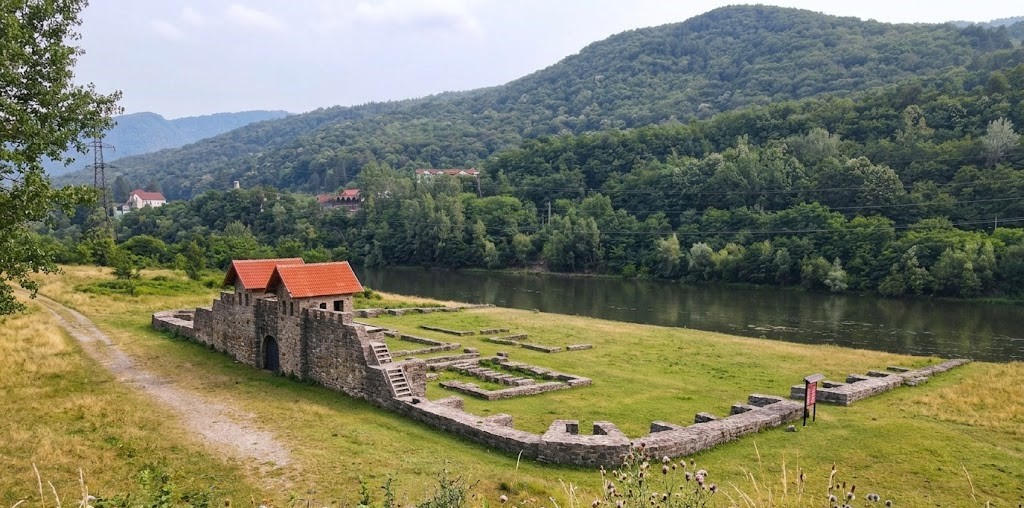
Standing proudly on the left bank of the Olt River, near the Cozia Monastery (see more), the Arutela Roman Castrum is one of the most significant archaeological monuments in the region. It was a vital link in the Limes Alutanus, a complex defense line built by the Roman Empire to guard the strategic passage through the Southern Carpathians into Dacia.
The History: Built by the Archers
The fortification was constructed during the reign of Emperor Hadrian, in 138 AD.
-The Syrian Archers: Inscriptions found at the site reveal that the castrum was built and manned by a specialized unit of Syrian archers (Suri Sagittarii). They were tasked with protecting the vital trade and military road that followed the river.
-The Flooded Ruins: For centuries, the ruins remained partially hidden. In the 1960s, during the construction of the hydro-energetic complex on the Olt, the original site was at risk of being completely submerged. To preserve it, the gate and part of the walls were reconstructed on higher ground, using original stone blocks where possible.
Legend: The Lost Roman Treasures
Local legends in the Călimănești area often speak of the "Sunken Roman Road."
- The Hidden Passage: It is said that when the Olt River was lower, before the dams were built, one could see the perfectly carved Roman road in the rock of the mountain.
- The Guardian’s Ghost: Some locals believe that on misty autumn nights, a Roman centurion can still be seen standing guard near the Arutela gate, protecting the mountain pass from "barbarian" invaders who never returned.
Biodiversity: Nature Reclaiming the Walls
Even though it is a stone structure, Arutela is surrounded by the rich nature of Cozia National Park:
- The Limestone Flora: Rare mosses and lichens grow on the ancient stones, while the surrounding cliffs are home to the Wallcreeper (Tichodroma muraria) (see more), a bird with striking crimson wings that lives in rocky crevices.
- The Olt Ecosystem: The waters right next to the castrum are home to several protected fish species, making the area a peaceful spot where ancient history and modern ecology coexist.
- Strategic View: The Romans chose this spot because it offered a perfect view of the "Gura Lotrului" (the mouth of the Lotru River), allowing them to spot any movement from miles away.
- Military Precision: The castrum follows a classic rectangular Roman design, and the reconstructed "Praetoria Gate" gives visitors a real sense of the scale and defensive power of the Roman army.
- Free History: Unlike many European ruins, Arutela is an open-air site that can be visited freely, offering a quiet moment of reflection away from the crowds of the nearby resort.
Frequently Asked Questions: Arutela Roman Castrum
1. Is Arutela the original Roman structure?
The site you see today is a faithful reconstruction of the Praetoria Gate and part of the walls, built in the early 1980s. The original 2nd-century foundations are located just a few meters away, but they were partially submerged when the Olt River level was raised for the construction of the nearby Cozia dam (see more).
2. Why did the Romans build a fort in this specific spot?
Arutela was a key point in the Limes Alutanus (the Roman defense line along the Olt River). It was strategically placed to guard the entrance to the Cozia Gorge, protecting the vital military and commercial road that connected the Danube to Transylvania.
3. Who were the soldiers stationed here?
Inscriptions found at the site mention a unit of Syrian Archers (Suri Sagittarii). These specialized troops were brought from the Eastern borders of the Roman Empire specifically for their elite combat skills in mountain terrain.
4. Can I visit Arutela at any time?
Yes. Arutela is an open-air historical monument located right on the bank of the Olt River. There are no fences or restricted hours, making it a perfect spot for a quick stop and some atmospheric photography, especially at sunrise or sunset.
5. Is there an entrance fee?
No, visiting the Arutela Roman Castrum is completely free. It is one of the most accessible historical sites in Romania, situated just a few hundred meters from the Cozia Monastery.
6. What else can I see near the Castrum?
Within walking distance, you can visit the Cozia Monastery (14th century) and the Turnu Monastery. Also, the hiking trails into Cozia National Park start nearby, offering a perfect blend of history and nature in a single afternoon.
7. How do I get there?
The castrum is located on the E81 (DN7) European road, between the towns of Călimănești and Căciulata. It is clearly visible from the road on the riverside, about 2 km north of the resort center.
