
A Labor of Love and Patience
Making a traditional Cozonac is considered an art form that requires time, warmth, and "soul."
-The Dough: It’s a brioche-like dough made with many eggs, butter, milk, and sugar. The secret to a fluffy Cozonac lies in the kneading—traditionally done by hand for at least half an hour until the dough "bubbles."
-The Filling: While there are many variations, the most iconic version is filled with a rich paste of ground walnuts, cocoa, and rum. Many also add raisins or "rahat" (Turkish delight) for extra texture and sweetness.
-The Braiding: The dough is rolled, filled, and often braided into beautiful shapes before being tucked into rectangular pans to rise once more.
Legends and Rituals
In Romanian villages, baking Cozonac was almost a sacred ritual.
- The Warm Room: Legend says that while the dough is rising, the house must be kept very warm, and no one should slam doors or speak loudly, as the "frightened" dough might not rise.
- Symbol of Abundance: A tall, well-risen Cozonac is seen as a sign of prosperity and good luck for the household in the coming year.
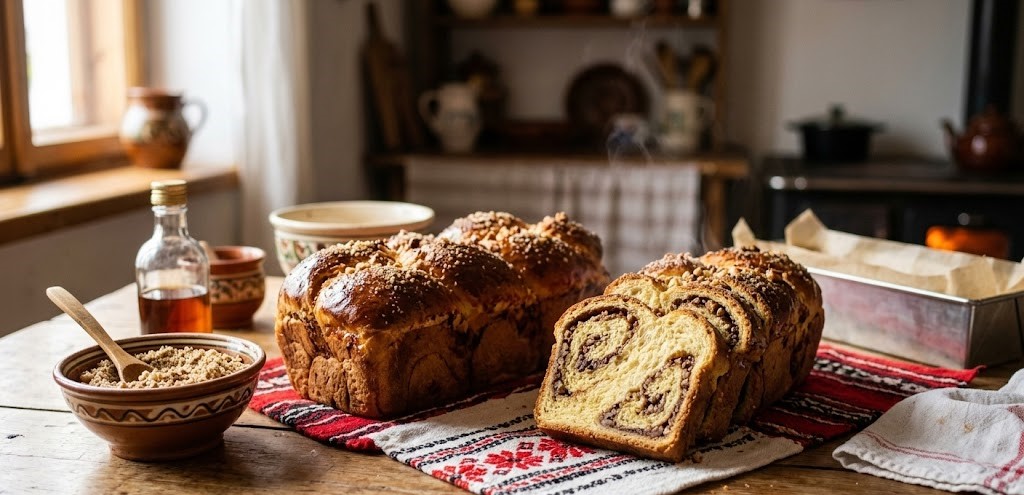
Varieties You Must Try
- Cozonac cu Nucă: The classic walnut-filled version, common across the whole country.
- Cozonac Moldovenesc: Famous in the Moldova region, these are often very tall, round, and use up to 20-30 eggs for a deeply golden, airy texture.
- Baigli: A variation popular in Transylvania, influenced by Austro-Hungarian traditions, featuring a thinner dough and a massive amount of filling (either walnut or poppy seeds).
This recipe makes 2 large loaves. It requires patience, warmth, and a bit of muscle for the kneading!
Ingredients
For the Dough:
1 kg of high-quality white flour (Type 000 is best)
500 ml of warm milk
50g of fresh yeast (or 14g dry yeast)
250g of sugar
200g of melted butter (82% fat)
5 egg yolks (at room temperature)
1 tsp of salt
Zest of one lemon and one orange
2 sachets of vanilla sugar or 1 tbsp of vanilla extract
For the Filling:
400g of ground walnuts
150g of sugar
3 tbsp of cocoa powder
4 egg whites (beaten to a foam)
2 tbsp of rum essence
Optional: 100g of raisins or Turkish delight (rahat)
Preparation Steps
1. The Starter (Maiaua)
In a small bowl, mix the yeast with 1 tablespoon of sugar, 2 tablespoons of warm milk, and a bit of flour until it becomes a thick paste. Let it rise in a warm place for about 15 minutes until it doubles in size.
2. The Dough
In a large bowl (or a stand mixer), put the flour and make a well in the center. Add the yeast starter, the egg yolks mixed with salt, the rest of the sugar dissolved in warm milk, and the citrus zest.
3. The Kneading (The Secret Part!)
Start kneading! Gradually add the melted butter.
By hand: Knead for about 30-40 minutes. Use a "fold and slam" motion. The dough is ready when it no longer sticks to your hands and you see small air bubbles inside.
By mixer: 15-20 minutes on medium-low speed.
4. The First Rise
Cover the bowl with a clean cloth and leave it in a warm, draft-free spot for 1.5 to 2 hours until it triples in volume.
5. Preparing the Filling
While the dough rises, mix the ground walnuts with cocoa, sugar, and rum essence. Gently fold in the beaten egg whites to create a spreadable paste.
6. Shaping and Braiding
Divide the dough into 4 equal parts. Roll each part into a rectangle on a greased surface. Spread the walnut filling evenly. Roll them up and braid two rolls together to form one loaf. Place them in greased baking pans.
7. The Second Rise
Let the braided loaves rise in the pans for another 30-45 minutes. Brush the tops with a beaten egg yolk mixed with a little milk and sprinkle with sugar or walnut halves.
8. Baking
Bake in a preheated oven at 170°C (340°F) for about 45-50 minutes. Tip: Do not open the oven door for the first 20 minutes!
Pro Tip for your Readers:
"Never use cold ingredients! To get that perfect fluffiness, make sure the eggs, flour, and milk are all at room temperature before you start. And remember, the room must be warm—Cozonac loves heat but hates drafts!"
A yammy video recipe of Cozonac:
FAQ: The Secrets of the Romanian Cozonac
1. Is Cozonac just a simple sweet bread?
Not at all! While it looks like a loaf, Cozonac is a rich, festive brioche-style dough. What makes it unique is the generous filling (walnuts, cocoa, raisins, or Turkish delight) that is swirled inside, ensuring that every bite is a perfect balance of fluffy bread and sweet cream.
2. Why is "kneading" so important in the recipe?
Traditionalists say the secret is in the kneading (frământat). For the Cozonac to become "fluffy" and pull apart in long, elastic threads (called fâșii), the dough must be worked by hand for at least 30-45 minutes. This develops the gluten and incorporates air, making it light despite the heavy amounts of butter and eggs.
3. What are the most popular fillings?
Walnut & Cocoa (Nucă și Cacao): The absolute classic.
Turkish Delight (Rahat): Colorful cubes that melt slightly into the dough.
Poppy Seeds (Mac): More common in Transylvania, offering a dense, earthy flavor.
Raisins (Stafide): Often soaked in rum for an extra kick of aroma.
4. When is the best time to eat Cozonac in Romania?
While you can find it in bakeries year-round, the "true" Cozonac experience happens during Easter (Paște) and Christmas (Crăciun). It is the centerpiece of the holiday table, usually baked in large batches to be shared with family, friends, and carolers.
5. How should I store it to keep it fresh?
Cozonac stays fresh for about 5 to 7 days if kept in a cool place, wrapped in a clean kitchen towel or paper bag. In fact, many Romanians believe it tastes even better on the second or third day, after the flavors of the rum and cocoa have fully settled into the dough.
6. Can I find a gluten-free or vegan version?
Traditional Cozonac relies heavily on milk, butter, and many eggs (some recipes call for 10-20 yolks!). However, modern Romanian pastry shops now offer vegan (de post) versions using nut milks and vegetable oils, which are very popular during the religious fasting periods before the big holidays.
