
The Mystery of the "Cioclovina Man"
The cave gained international fame when a skull fragment, belonging to a woman who lived approximately 30,000 years ago, was discovered here. Known as the "Cioclovina Woman," this find is one of the oldest human remains ever found in Romania. Legend has it that the cave was a sacred site for the Dacians, a place where the mountain spirits were appeased with offerings, hidden deep within the labyrinth of stone.
Biodiversity: A World Without Light
Life in Cioclovina is subtle but extraordinary.
-The Bone Depository: One of the most striking features is the massive accumulation of Cave Bear (Ursus spelaeus) bones. Thousands of these giants sought refuge here during the last glaciation, and their remains are still being studied today.
-Cave Dwellers: The cave is home to unique colonies of bats and specialized invertebrate species that have adapted perfectly to the constant temperature and total darkness of the subterranean world.
-The "Moonmilk": In certain galleries, you can find rare formations of "moonmilk"—a soft, white, cream-like mineral substance that was once used by ancient peoples for its supposed healing properties.
Fun Facts & Curiosities
-A Double System: There are actually two caves: Cioclovina de Sus (the dry one, famous for fossils) and Cioclovina de Jos (the active one, where a river still flows). They are connected by a vertical shaft that only expert cavers can navigate.
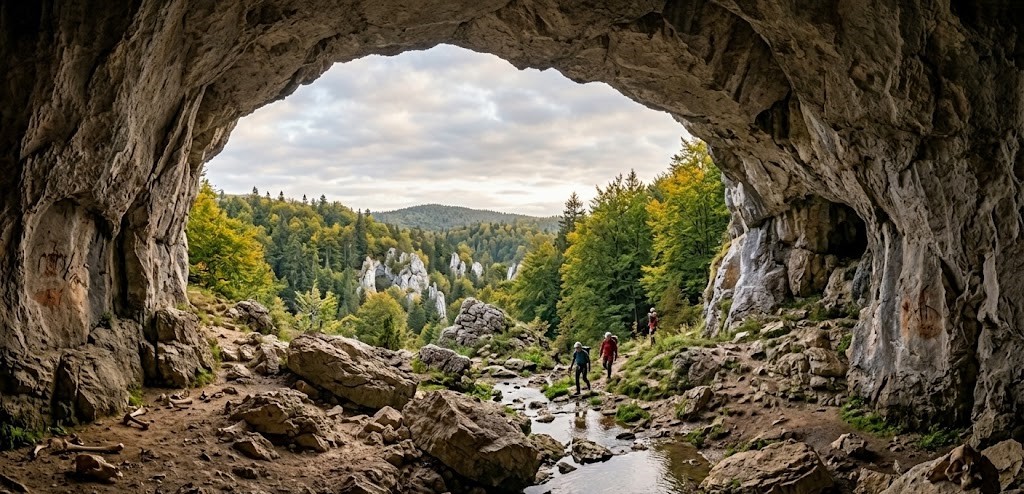
-The "Cave of Lights": Many visitors report that the way the light filters through the entrance of Cioclovina de Sus creates an almost mystical, cathedral-like atmosphere.
-Crystal Columns: The cave houses some of the most impressive calcite formations in the region, some reaching several meters in height.
The Legend of the Amber Offering
Beyond its geological wonders, Cioclovina Cave is steeped in ancient Dacian mysticism. Local lore and archaeological finds suggest that this was not just a shelter, but a subterranean cathedral dedicated to the gods of the underworld.
A Portal to Zamolxis: It is said that the high priests of the Dacians considered the cave a gateway to the realm of their supreme deity, Zamolxis. During times of great peril—war or devastating drought—they would trek into the heart of the Şureanu Mountains to seek guidance from the spirits dwelling in the dark.
The Ritual Treasure: This legend is backed by an incredible real-world discovery: a massive hoard of over 6,000 amber beads, along with bronze and glass ornaments, hidden deep within the cave. Unlike typical treasures hidden for safekeeping, these were carefully placed as ritual offerings. It is believed that the ancients "sacrificed" these precious objects to appease the mountain spirits, ensuring the protection of their fortresses.
Whispers of the "Old One": To this day, locals in the surrounding villages tell stories of strange, rhythmic sounds echoing from the cave’s mouth during full moons. They say it is the wind playing the stone like an instrument, but some prefer to believe it is the "Spirit of the Cave" still chanting ancient protection spells over the land of the Dacians.
Why Visit?
Cioclovina is for the true explorer. It doesn't have the colorful lights of tourist caves; it offers raw, authentic silence and the feeling that you’ve stepped back into the Paleolithic era. It is a place where you can literally touch the history of our species.
A video presenting explorers inside the Cioclovina Cave:
Frequently Asked Questions: Cioclovina Cave (Peștera Cioclovina)
1. Is Cioclovina Cave open to the general public?
Unlike "show caves" with paved paths and electric lighting, Cioclovina is a wild cave. While the massive entrance of Cioclovina de Sus (the dry cave) can be visited by hikers with a powerful flashlight and sturdy boots, the deeper galleries and Cioclovina de Jos (the active water cave) are strictly for experienced speleologists with professional equipment.
2. Where exactly is it located?
It is located in the Grădiștea Muncelului-Cioclovina Natural Park in Hunedoara County, near the village of Cioclovina (see more). The area is also famous for being the heartland of the ancient Dacian civilization.
3. What makes the "Cioclovina Woman" find so special?
The skull fragment found here dates back approximately 30,000 years. It is one of the most complete early modern human fossils from the Upper Paleolithic in Europe, providing crucial data about how our ancestors migrated and lived during the Ice Age.
4. Can I see the Cave Bear fossils?
Yes, the cave is famous for its vast deposits of Cave Bear (Ursus spelaeus) bones. In some areas, the floor is literally covered in the remains of these extinct giants. However, it is strictly forbidden to touch or remove any fossils, as the site is a protected scientific monument.
5. How long does it take to reach the cave?
The hike to the cave entrance usually takes about 1 to 1.5 hours from the nearest accessible road point. The trail goes through beautiful, dense forests and limestone plateaus. Be prepared for a moderate climb.
6. Are there wild animals in the area?
The Șureanu Mountains are very wild. As always in Romania, wild animals are unpredictable. You are in the heart of bear and wolf territory. It is highly recommended to hike in groups and stay on the marked trails within the Natural Park.
7. Do I need a permit to enter?
For the entrance area of the dry cave, no special permit is needed, but for the technical, flooded, or protected galleries, you must obtain permission from the Park Administration and the Speleological Heritage Commission.
