
Let’s start with the man himself, Vlad Țepeș. He was born a long time ago, around 1431, in Sighisoara (see more) - a citadel that still stands today, holding many stories and undiscovered mysteries. He was the son of Vlad Dracul (a defender of Christianity), which is where the pseudonym "Dracula" comes from. He became the ruler of Wallachia and was a master military strategist, achieving many successes on the battlefield at that time.
What brought him fame, however, was the brutality and lack of mercy with which he served justice. Outlaws were impaled, imagine a spear over two meters long, usually inserted through the back and exiting through the chest. Though brutal, this technique was meant to discourage the criminals of those days. Historical accounts say he died in 1476 during a battle, and his head was sent to the Sultan in Constantinople-his mortal enemy.
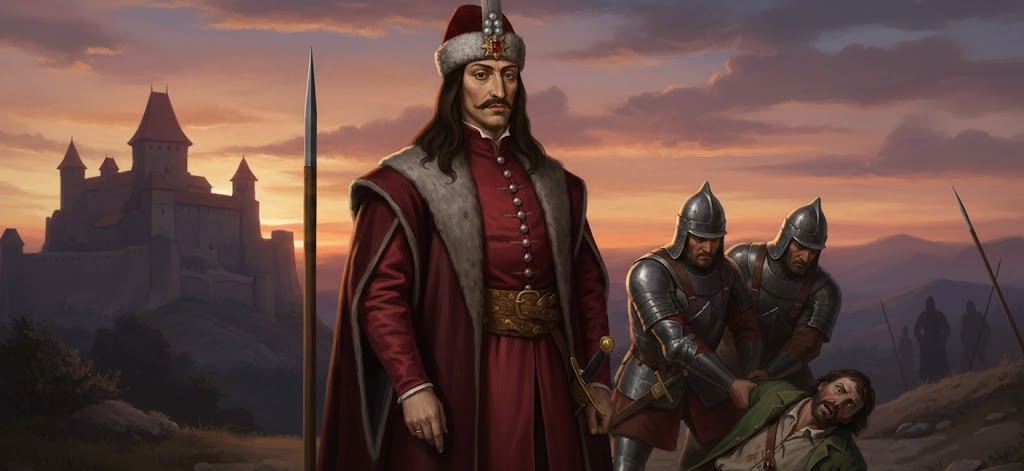
Now, let’s talk about the "Dracula" myth. Bram Stoker’s novel (1897) is the primary reason why a ruler known for his unyielding , and sometimes brutal judgment of criminals became linked to a vampire story and the legendary Bran Castle (see more).
In reality, the harsh truth is that Dracula is just a legend- a beautiful one that sparks the imagination of the entire world, including us Romanians. If we were to associate the ruler Vlad the Impaler with a monster, it would only be because of the cruelty he used to enforce justice, though such methods were not uncommon at the time.
As for Bran Castle, there is no historical evidence that the Prince ever resided there; on the contrary, it is well known that Poenari Fortress (see more) was his main stronghold. However, returning to the myth, Bran Castle possesses that mysterious, legendary atmosphere that perfectly suits a fierce guardian like Dracula. Legends aren't necessarily meant to be scientifically proven; they are created to evoke emotions, moods, and sometimes lessons. If we all enjoy this legend, it doesn't even matter anymore whether it truly existed or not.
And what about you, dear reader - what is your take on this? Please feel free to add your thoughts or bring other arguments to the table; don't be shy (hehee)!
With respect, Laurentiu, the administrator.
