
A Subterranean Giant
The cave was discovered in 1959 during blasting operations at a gypsum quarry. What lies beneath is a massive labyrinth of galleries spread across several levels.
- Size and Scale: With a total length of over 90 kilometers, the cave is famous for its vast galleries, some of which are wide enough to be called "cathedrals."
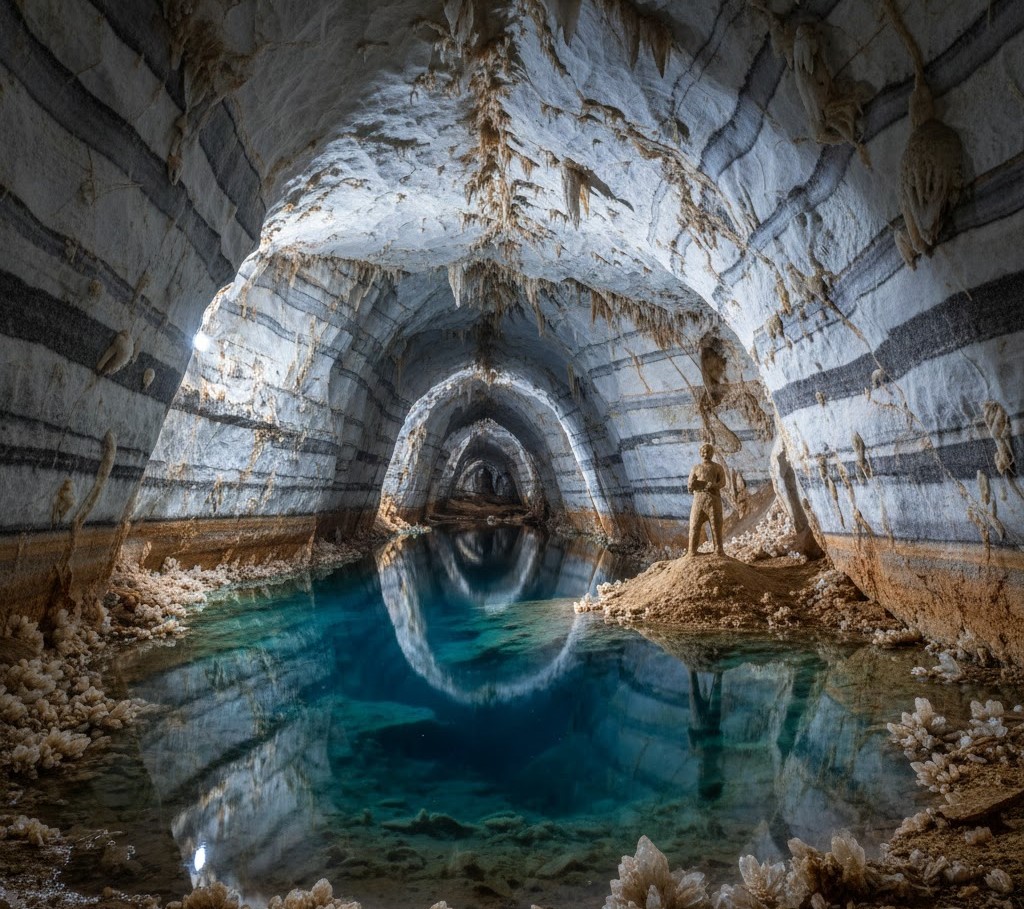
- Mineral Beauty: Being a gypsum cave, it features unique formations. Instead of stalactites, visitors can find giant crystals and fine gypsum "flowers" that sparkle under artificial light.
- Underground Lakes: The cave houses more than 20 subterranean lakes, such as "The Blue Lake" and "The Dinosaur Lake," whose still waters create perfect mirrors of the jagged ceilings.
Biodiversity: Life in the Dark
Despite the lack of light, the cave is a laboratory for life. Following Emil Racoviță’s legacy, scientists have studied the specialized fauna here.
- Cave Dwellers: The ecosystem includes microscopic crustaceans and specialized insects that have adapted to the high humidity and constant temperatures of the cave.
- The "Criva" Bat Colonies: The cave provides a vital sanctuary for several species of bats, which use the deep galleries for hibernation away from human interference.
Unlike the ancient caves of the high peaks, the legends of the Emil Racoviță Cave are a mix of local folklore and the mysterious accounts of the explorers who first braved its depths.
The Legend of the Infinite Labyrinth: Since its discovery in 1959, a persistent local myth suggests that the cave’s galleries are far more extensive than any map shows. Some locals believe the tunnels stretch deep beneath the Prut River, crossing international borders and linking distant villages through the belly of the earth. It is whispered that there are "hidden gates" within the cave that lead to chambers yet unseen by human eyes.
The Guardian of Clay: A unique tradition among explorers has given rise to the legend of the "Captain's Statue." Deep within the cave, speologists have carved figures out of the wet, fine clay. The most famous is a silent guardian known as "The Captain." According to modern lore, he is the protector of the cave’s crystals. It is said that those who enter with disrespect or intent to harm the formations will find themselves walking in circles, led astray by the Captain until they learn to respect the silence of the abyss.
The Lakes of Healing: The subterranean lakes, such as the Blue Lake and the Dinosaur Lake, are steeped in tales of "Living Water." Because the water is filtered through massive layers of gypsum for millennia, local legend attributes healing properties to these pristine pools. It is believed that the mineral-rich, untouched waters can heal the eyes and spirit of anyone brave enough to reach them.
The Scientific Legacy
Emil Racoviță, the cave's namesake, was the first scientist in the world to study life in the underground environment systematically. By documenting this cave, we honor his contribution to the Antarctic Belgica Expedition and his founding of the First Institute of Speleology in the world (Cluj-Napoca, Romania).
Traveler Tips
- Access: The cave is located near the village of Criva. Access is strictly regulated and usually requires professional equipment and a licensed guide.
- Conditions: The humidity is very high (nearly 100%), and the floor is often covered in fine clay ("the cave butter"), making navigation a challenge even for experienced cavers.
- Special Equipment: High-quality lighting and protective suits are mandatory due to the labyrinthine nature and the narrow passages between larger halls.
A video which present Emil Racoviță Cave (Pestera Emil Racoviță):
Frequently Asked Questions: Emil Racoviță Cave
1. Where is the Emil Racoviță Cave located?
The cave is located in the northern part of the Republic of Moldova, near the village of Criva, right at the border crossing between Romania, Moldova, and Ukraine. It is part of a larger geological formation shared by the entire region.
2. Is it true that it is one of the longest caves in the world?
Yes. It is the third-longest gypsum cave in the world and one of the longest overall in Europe, with over 90 kilometers (approx. 56 miles) of mapped galleries.
3. Does the cave have underground lakes?
Absolutely. There are more than 20 subterranean lakes within the cave system. The most famous ones are the Blue Lake, Dinosaur Lake, and Nautilus Lake. The water in these lakes is exceptionally pure, filtered naturally through the gypsum layers.
4. Why is it called a "Gypsum" cave?
Most caves are formed in limestone. This cave is unique because it was carved into a massive layer of gypsum (a soft sulfate mineral). This gives the cave its characteristic white and amber colors and creates spectacular large crystals that you won't find in common caves.
5. Can I visit the cave as a tourist?
Access is highly restricted. Because it is a scientific reserve and the environment is a complex labyrinth with high humidity and slippery clay, it is not open for mass tourism. Visits are usually reserved for organized groups of speleologists and researchers with special permits.
6. Who was Emil Racoviță?
Emil Racoviță (1868–1947) was a world-renowned Romanian scientist and explorer. He was the first biologist to join an Antarctic expedition (the Belgica) and is the founder of Biospeleology, the study of life in underground environments.
7. What should I bring if I get a permit to visit?
If you are part of a professional expedition, you will need:
- A specialized waterproof suit (due to the "cave butter" or fine clay).
- Multiple high-intensity light sources.
- A helmet and professional-grade hiking boots.
- An experienced guide—it is extremely easy to get lost in the 90km labyrinth.
