
A Palette of Natural Colors
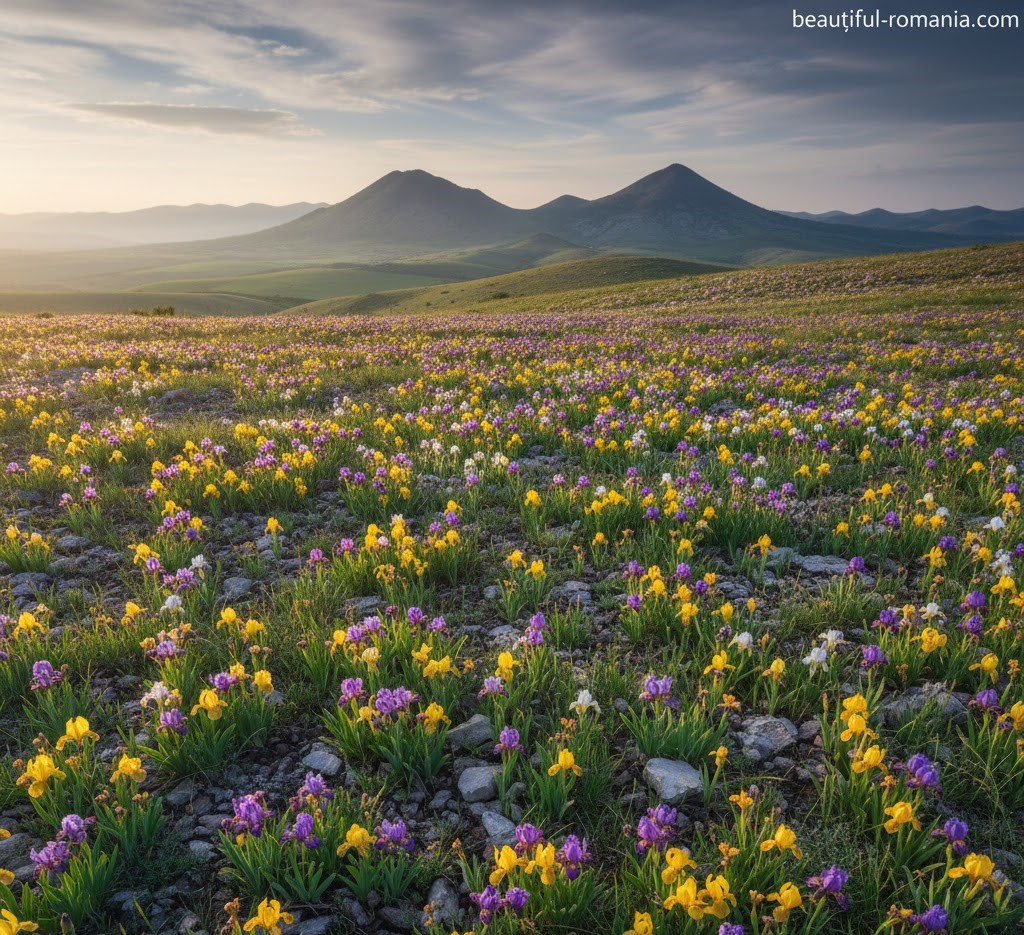
One of the most fascinating aspects of the Steppe Iris is its color diversity. Unlike many other wild flowers, you can find them in a variety of shades in the same meadow:
- Deep Purples and Violets: The most iconic and common colors.
- Golden Yellows: Often found interspersed with the purple varieties.
- Pale Blues and Whites: Rarer, but equally stunning when discovered.
The Legend of the Iris: The Rainbow Bridge
The name "Iris" comes from Ancient Greece, but the story has resonated through the centuries across the Romanian plains. According to legend, Iris was the goddess of the rainbow and a messenger for the gods. She used the rainbow as a bridge to travel between the heavens and the earth, delivering messages of hope and divine will to mortals.
It is said that wherever the goddess stepped upon the dry, parched earth of the steppe, vibrant flowers bloomed in the tracks of her colorful robe. These flowers captured the very essence of the rainbow, which explains why the Steppe Iris appears in so many different colors—purples, yellows, and blues—all in the same meadow.
In Romanian folklore, these "stânjenei" are often called "the keys to the sky." Legends say that when the first irises bloom in the spring, they unlock the gates of the sun, bringing warmth and light back to the world after the long winter. Because they grow on rocky slopes and harsh plains, they are also seen as symbols of resilience and hidden beauty, proving that even in the toughest environments, something magnificent can flourish.
Built for the Steppe
The Steppe Iris is a master of adaptation. It grows low to the ground (usually only 10-15 cm tall) to protect itself from the strong winds of the open plains. Its thick, fleshy rhizomes store energy and water, allowing it to survive in rocky or sandy soils where other plants might struggle.
Where and When to See Them
If you want to capture the perfect photo for our forum, timing is everything:
- Season: They typically bloom from late March to early May, depending on the warmth of the spring.
- Locations: Look for them in the Măcin Mountains National Park (Dobrogea), the Transylvanian Plain (Câmpia Transilvaniei), or the sunny slopes near Cluj-Napoca city (see more) (Fânațele Clujului).
The Steppe Iris is a protected species in Romania. Because it relies on specific, undisturbed steppe habitats, it is vulnerable to intensive agriculture and overgrazing. We encourage all visitors to beautiful-romania.com to follow the "look, don't touch" rule—photograph these beauties, but never pick them, so they can continue to spread their seeds for future generations.
A video presenting The Steppe Iris (Stânjenelul de step) in Măcin Mountains (see more):
FAQ: Discovering the Steppe Iris
1. Why does the Steppe Iris have different colors in the same field?
This is a rare natural phenomenon called polymorphism. Unlike most flowers that stay one color to attract specific pollinators, the Steppe Iris has evolved to display a variety of shades—from deep violet to bright yellow—within the same colony, making every meadow unique.
2. When is the best time to photograph them?
The blooming window is quite short, usually lasting only 2 to 3 weeks. In Romania, the peak is typically between mid-April and early May. For the best light, we recommend visiting the steppe at sunrise when the dew is still on the petals.
3. Are these flowers protected by law in Romania?
Yes. Many of the habitats where the Steppe Iris grows, such as the Măcin Mountains or the Transylvanian hills, are protected areas. Picking the flowers or digging up the rhizomes is strictly prohibited and can result in significant fines.
4. How big does a Steppe Iris actually get?
It is a dwarf species. Unlike garden irises that can reach nearly a meter, the wild Steppe Iris is very small, usually between 10 cm and 15 cm. Its beauty lies in its miniature, delicate proportions.
5. Why is it called "Stânjenel" in Romanian?
The name "stânjenel" is a diminutive of "stânjen," an old unit of measurement. It refers to the elegant, upright shape of the plant's leaves and stem, which look like tiny, well-proportioned spears or rods.
6. Where is the most famous place to see them?
One of the most spectacular locations is Fânațele Clujului near Cluj-Napoca, a botanical reservation famous for its "moving hills" and incredible biodiversity, where the Steppe Iris is a star attraction.
