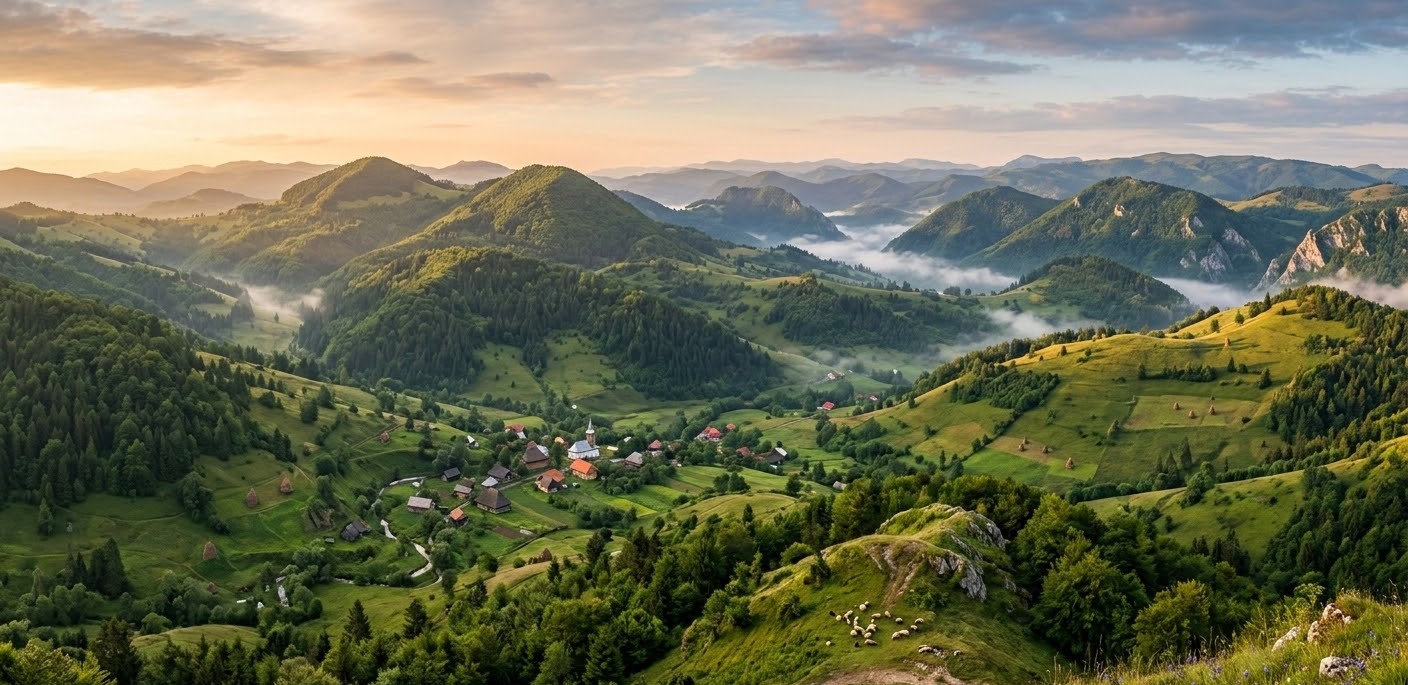
The Realm of Limestone and Water
The Apuseni are famous for their "karst" topography. Over millions of years, water has sculpted the limestone into a subterranean masterpiece.
- Scărișoara Ice Cave (see more): Home to the second-largest underground glacier in Europe. Some of the ice here is over 4,000 years old.
- The Bears' Cave (Peștera Urșilor) (see more): Named after the remains of the extinct Cave Bear (Ursus spelaeus) found inside, this cave features extraordinary stalactite formations that look like frozen waterfalls.
- Turda Gorge (Cheile Turzii) (see more): A dramatic canyon with vertical walls reaching 200m in height, offering some of the most spectacular hiking trails in Romania.

Flora and Fauna:
A Sanctuary of BiodiversityThe Apuseni are a haven for wildlife. Because the mountains are not as high as the Meridionals (maximum altitude is 1849m at Cucurbăta Mare), the forests are dense and vibrant.
- Wild Creatures: These woods are home to the Carpathian Brown Bear (see more), wolves, and the elusive lynx. In the higher cliffs, you can often spot The golden eagle (see more) soaring.
- Floral Treasures: In the spring, the mountain meadows are carpeted with wild orchids, gentians, and the rare Lady's Slipper (Cypripedium calceolus). The ancient spruce and beech forests provide a cool, mossy sanctuary for rare ferns.
Local folklore says that these mountains were once inhabited by Giants who helped shape the valleys.
-The Legend of Detunata: Two basalt peaks, Detunata Goală and Detunata Flocoasă, are said to be two brothers turned to stone. Legend says they were giants who fell in love with the same fairy, and their tragic conflict ended when the earth swallowed them, leaving behind the massive basalt columns we see today.
-The Solomonari: The elders still tell stories of the Solomonari—powerful wizards who could control the weather and ride dragons. It was believed they lived in the deepest caves of the Apuseni, emerging only to bring rain or hail when the villagers forgot their traditions.
Why Visit?
The Apuseni Mountains are not just about landscapes; they are about a slower pace of life. Here, you will see the traditional wooden houses with tall, thatched roofs and hear the haunting sound of the Tulnic (a long wooden instrument) echoing through the valleys—a call that has been used by locals for centuries to communicate between mountain tops.
A video which present The Apuseni Mountains (Muntii Apuseni):
- FAQ: Exploring the Apuseni Mountains
Unlike the higher and more rugged Southern Carpathians, the Apuseni are famous for their karst landscape. This means they house over 7,000 caves, deep gorges, and underground rivers. It is the most inhabited mountain region in Romania, where traditional life still thrives at high altitudes.
2. What are the "must-see" natural landmarks?
The most iconic locations include:
- Scărișoara Ice Cave: Europe’s second-largest underground glacier.
- The Ponor Fortresses Cave (Cetățile Ponorului) (see more): A massive natural karst citadel.
- Turda Gorge (Cheile Turzii): A spectacular canyon near the city of Turda.
- The Bride's Veil Waterfall (Cascada Vălul Miresei) (see more): One of the most beautiful waterfalls in the country.
4. Will I encounter wild animals?
The Apuseni are home to bears, wolves, and lynx. While these animals usually avoid humans, please remember that wild animals are unpredictable. Do not leave food remains on the trails and avoid hiking alone at night.
5. What is the "Land of the Moți" (Țara Moților)?
It is the cultural heart of the Apuseni. The Moți are the local inhabitants known for their woodcrafting skills and their unique musical instrument, the Tulnic. Their traditional houses and way of life are a key part of the region's beauty.
6. When is the best time to visit?
- Spring/Summer: For lush green landscapes, wildflower meadows, and cave exploration.
- Autumn: For the spectacular colors of the beech and maple forests.
- Wintert For traditional scenery and skiing in areas like Arieșeni.